Showing posts with label History of Postage Stamps. Show all posts

Sunday, April 10, 2022

A Most Rare Postal Card From Bhutan: Land Of The Thunder Dragon

It has been reported that during late 2019, a unique and rare Postal Card was auctioned off among the worldwide philatelists – fetching several hundred dollars as bid price. This Postal Card originated in Bhutan – The Land Of The Thunder Dragon. The Card was rare in every sense of the word - because it had elements of uniqueness about it that few can fathom.

~  The Postal Card was Bhutan's – but it was mailed from another country – from the Kingdom of Sikkim;

~  Curiously, the Postal Card was affixed with stamps of two independent nations – Bhutan and India;

~  While the Postal Card was mailed from Sikkim, Indian postage stamp was used - presumably because
     Sikkim never issued its own postage stamps;

~  During the time when the Postal Card was written out sometime most likely between 1957 - 1962,
     Bhutan did not have a postal service – Bhutan’s postal service was established only in October of 1962;

~  The Postal Card ought to have the distinction of being among the rarest case where a fiscal stamp was used,
     and accepted, on an international mail cover;

~  The Postal Card also must be the only Postal Card on which a stamp was affixed – although the mail
     would have been delivered on foot by a postal runner over the Nathu-La Pass in Sikkim;

~  Best of all, the Postal Card was mailed by a reigning Queen of an independent Monarchy
     – the Kingdom of Bhutan.

Back of the Postal Card: Depicting Dechencholing Palace, Thimphu as seen during mid 1950s

The front of the rare Postal Card - dated 18th June, affixed with stamps of two different countries - carrying cancellation mark of Gangtok Post Office and most likely that of the personal seal of Her Majesty the Queen of Bhutan

Other perplexities are the following:

The Postal Card has a date – but no year.

Her Majesty the Queen writes, “This is our new house in Thimphu” – indicating that the photo on the back of the Postal Card was that of Dechencholing Palace.

The construction of Dechencholing Palace was completed in 1953. This means that the Postal Card would have to have been posted after 1953/1954. This would be correct since the IVth King of Bhutan His Majesty Jigme Singye Wangchuck was born in Dechencholing Palace on November 11, 1955 – proving that the Royal Couple was resident in Dechencholing Palace in 1955.

However, the fiscal that was affixed on the Postal Card was issued only in 1954 – thus the Postal Card would have to have been mailed after 1954. But that is unlikely since the use of the fiscal as postage - for internal mail - was authorized by the Third King only as of September 17, 1955.

Thus, the Postal Card would have to have been mailed sometime between September 17, 1955 and October 10, 1962. After October 1962, Her Majesty would have used regular postage stamps.

What is even more mysterious is that the Postal Card is quiet apparently a machine printed Card – the pre-printed dotted lines and the bold line at the bottom of the right face of the Card is proof of it. Normally a country’s postal authority issues Postal Cards – but our modern postal service was established only in October 10, 1962. Thus, the existence of a printed Postal Card reinforces the fact that there did exist a form of organized mail service within the country – even before the advent of modern postal service.

A machine printed Postal Card in use - validating the fact that a form of mail service existed in the country even before the arrival of modern postal service

The Postal Card is addressed to the wife of George Sherriff, the Scottish explorer and plant collector who made a number of trips to Bhutan accompanied by the English naturalist Frank Ludlow - their last trip being in 1949. Our National Butterfly - Ludlow’s Bhutan Swallowtail (Bhutanitis ludlowi) was discovered during their trip in 1933-1934.

Saturday, April 9, 2022

Refining Postal History of Bhutan

One reader of my blog writes as follows:

"Note that according to the map on the stamp depicting His Majesty Gongsa Ugyen Wangchuck, the country north of Bhutan is Tibet, which was already taken over by China at the time of the release of this 1st stamp set in 1962. So there were also speculations that that was one more reason to withdraw this particular stamp from especially domestic usage".

This was with respect to my blog post titled “Bhutan's Earliest Postage Stamp Gives Joy To A Sikkimese". Please read the full article at:

https://yesheydorji.blogspot.com/2020/12/bhutans-earliest-postage-stamps-gives.html

The reader implies that one of Bhutan’s earliest postage stamps – a set of seven, issued in 1962 had some serious problems – resulting in it having to be withdrawn from circulation. The stamp was the one depicting His Majesty Gongsa Ugyen Wangchuck, Bhutan’s first hereditary monarch. The stamp had two problems: wrong date of birth/death of the monarch and a serious diplomatic faux pas!

Supposedly withdrawn from circulation for a number of errors

The first problem with the stamp was that it depicted the image of Gongsa Ugyen Wangchuck with his date of birth/death wrongly rendered. The other problem was that the Tibetan Autonomous Region of China was named as Tibet, not realizing that Tibet was effectively a part of China as of 7th October, 1950.

The nation states of Sikkim and East Pakistan are named correctly - Bangladesh came into being only in 1971 and Sikkim was annexed by India only in 1975.

Friday, April 8, 2022

Bhutan's Never Released Liquid Crystal Scout Stamps of 1973

An article appearing in the March, 2022 issue of the Postal Himal 189 titled “The Premature Announcement of the Bhutan Liquid Crystal Scout Stamp Issue of 1973” authored by Leo van der Velden, some very interesting accounts pertaining to our postal history have been reported.

In a letter dated July 22, 1969 addressed to late Lyonpo (Minister) Dawa Tshering who then served as the Minister for Development, Burt Kerr Todd, a part shareholder of the company appointed as worldwide Agent for marketing of our postage stamps until 1974 based in Nassau, Bahamas, wrote as follows - quoted verbatim:

Dear Mr. Tshering,

We have discovered a remarkable process, just invented by a very small company here in the United States, which we think is one of the most revolutionary discoveries of our time. Made into a stamp issue, it would be another first in the world for Bhutan.

In response, by a letter dated December 22/23, 1969, Lyonpo Dawa Tshering conveys the approval of the Royal Government of Bhutan for the production of the proposed stamp, using the “revolutionary” process, as Burt K. Todd described it.

Letter of Approval for the production of the Liquid Crystal Issue Stamps

Sadly, the self-adhesive imperforate stamps never saw the light of day because, subsequently, on January 3, 1974 the Royal Government of Bhutan, via a telegram, forbade Burt K. Todd's company from producing the proposed stamps. Ofcourse by then the stamps were already produced and its release date of December 28, 1973 was prematurely announced to the world collectors by Burt K. Todd’s company – Bhutan Stamp Agency, Ltd., on December 6, 1973,

The stamps in question were a series depicting the following four emblems of the Scouts movement.

The Liquid Crystal Stamps depicting the emblems of the Boy Scouts, Girl Scouts, Life Scouts and International Scouts

In his letter to Lyonpo Dawa Tshering, the “revolutionary” production process of the stamps, involving liquid crystals, were described by Burt K. Todd in his following exact words:

The process is called Liquid Cristals. This exciting phenomenon are crystals bonded between microthin plastic, which change color (all spectrums of the rainbow) in response to minute changes in temperature. A slight increase in temperature and they scatter brilliant reds, yelloes, greens, blues and violets in that order. On cooling, they reverse themselves to complete a cycle that can be repeated over and over. The crystals can detect a change in temperature in one-fifth of a second.

The stamp series were to be called the “Liquid Crystal Scout Stamp Issue of 1973”. They never saw the light of day. However, some quantity of these stamps was delivered to the P&T Department in Phuentsholing where they were reportedly destroyed – but apparently not before 200 sets of these stamps were stolen by someone in the P&T Department. These stamps which were never released found their way into the international collectors market. A collector even has a cover with the Liquid Crystal Scout Stamp affixed on it with official cancellation stamp of Phuentsholing Post Office, dated 10.11.1972. This has to be an inside job of a person working within the P&T Department.

A cover with the never released Liquid Crystal Scout Stamp affixed on it and bearing the cancellation mark of the Phuentsholing General Post Office

It appears that there was an in-house thief lodged inside the confines of the P&T Department in Phuentsholing who regularly lifted unissued stamps and sold them to collectors around the world.

It is provable that this same person was also responsible for the lifting and release of the "1974 Reading and Writing Series" of stamps – many years before the official release of the stamps on 2nd May, 1993, after having remained locked up in the Bhutan Customs warehouse in Phuentsholing for close to twenty years. Please read the full detail of the case at:

https://yesheydorji.blogspot.com/2022/03/languished-for-20-years-inside-bhutan.html

From all accounts our postal history appears to have been shaped by numerous colorful events – unfortunately most of them rather unsavory ones.

Tuesday, March 8, 2022

Bhutan’s Postage Stamps: Fakes & Counterfeits

As I mentioned in my yesterday’s post, while the country was still relatively an unknown entity, it appears that our postage stamps attracted a number of fakers and counterfeiters. In a way it should be a matter of pride that so many fakes and counterfeit stamps of Bhutan were produced. It goes to prove that our stamps are popular and sought after by the global collectors. On the downside though, it must be bad business for Bhutan Post who would be losing a substantial market share to spuriously produced stamps.

The following are some of the fakes/counterfeits:

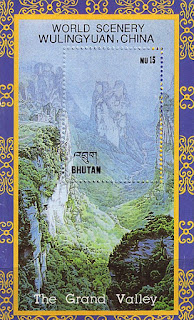
WORLD SCENERY WULINGYUAN, CHINA

A fake intended for the world stamp collectors.

A pretty looking fake - most likely faked in China

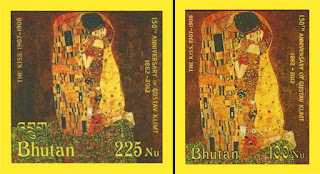
150th ANNIVERSARY OF GUSTAV KLIMT’s “THE KISS”

These stamps were total fakes. No one knows who created these. They were auctioned to unsuspecting collectors around the world. Like our original silk series of stamps depicting Thangkas, these fakes too were printed on silk.

Faked in silk - 150th Anniversary of Gustav Klimt's "The Kiss"

AFRICAN ANIMAL SERIES

Another fake targeted at the collectors – Bhutan Post never issued these stamps. As is evident, this was a poor job – notice that the alphabet “u” after “N” in Nu. is missing.

A set of 9 stamps depicting animals found in Africa

JESUS SERIES

Yet another fake – this time with Christian overtones. Beautifully printed though – but fakes will always remain fakes, regardless.

Did this set of 9 fake stamps go to fund proselytism in rural Bhutan?

One long time collector of Bhutanese stamps opined that this could have been the work of a Christian zealot – as retaliation for barring him/her entry into Bhutan. My own view is that the faked stamps may have been produced to raise funding for the conversion of Bhutanese into the Christian faith. You may recall that some years back there were rampant conversions in the remote villages of Bhutan – so much so that the government had to intervene by bring out a law that prohibited conversion from one religion to another. It is clear that the same people who faked the African Animal series were responsible for this thuggery as well – given that these fakes also has “u” missing after the alphabet “N” in Nu.

The following 1999 Goldfish Set is an example of poorly executed fakes. While the stamp was touted as being Bhutanese – the value of the stamp is denominated in Laotian currency. 

An amateur's job - very badly executed

Another poorly executed counterfeit is the following “Save The Tiger” stamps issued by Bhutan Posts during the Male Iron Tiger Year in 2010. The counterfeit depicts the logo of WWF in gold while the original on the left does not have the logo on the stamps.

Very poor counterfeit of the "Save The Tiger Year" issue of 2010

The worst example of a counterfeit is the following Bhutan’s fiscal stamp of 1954. Whoever the cad was who did it, he/she used a rubber stamp to surcharge the stamp. I cannot imagine why someone would counterfeit a fiscal stamp. Perhaps the reason could be because, for a short while, before the coming of the postage stamps in 1962, His Majesty the Third King had issued a Kasho authorizing the use of fiscal stamps as postage stamps.

The counterfeiter tried to get away cheaply - he/she simply rubber stamped the real stuff.

In conclusion, I have to emphasize that we should be clear on what is a fake and what is a counterfeit. A very authoritative collector and historian went to great length to explain to me the difference between the two. He clarified that “fake” is when someone invents and entirely new design and content – totally unrelated to anything the Bhutan Posts had released.

Counterfeit on the other hand is something that a faker had attempted to reproduce an original item issued by the Bhutan Posts. In other words it is a copy.

Monday, March 7, 2022

Languished for 20 Years inside Bhutan Customs' Warehouse!!

I can sense that not many Bhutanese are interested in our history. We should be – because history can reveal to us why we ARE where we are – including why we are NOT where we are not. History is simpler to understand and decipher – then the future, which is fraught with uncertainties and ambiguities.

Consider, for instance, that not many Bhutanese today are aware that Bhutan’s first baby steps onto the global platform was made possible through our postage stamps. That is right – Bhutan began to be unraveled to the outside world through our postage stamps. At one point in history, postage stamps accounted for the bulk of our foreign exchange earnings.

Bhutan’s history of postage stamps begins on the 10th of October, 1962 – the day on which Bhutan released our first postage stamps – a set of 7 stamps, including the establishment of our first Post Office in Phuentsholing. There is some confusion as to how it all began. One oft repeated version is that it was as a result of the World Bank refusing to grant us a loan. It is said that Bhutan started to issue stamps to sell to the international philatelic world, to earn some much-needed revenue. I do not believe this story – for the simple reason that Bhutan became a member of the World Bank only in 1981. Thus it is not possible that we went to the World Bank seeking for a loan.

Well, never mind the confusion of how it started – there are two other aspects to our postage stamps that are even more interesting. The first is that according to the accepted view/history – the terms Ngultrum (Nu.) and Chetrum (Ch.) were coined when we planned the issue of our first paper currencies, in 1974. This does not seem plausible since Burt Kurt Todd who was contracted to bring out our postage stamps in 1962 used the terms Nu. and Ch. on the first seven postage stamps released by Bhutan.

Bhutan's earliest postage stamps issued in 1962 denominated in Nu. and Ch.

Including this post, I have written 15 articles on the history of Bhutan’s postage stamps – please read them at:

https://yesheydorji.blogspot.com/search/label/History%20of%20Postage%20Stamps

The second interesting thing about our postage stamps is that while the country was still a relatively unknown entity, it appears that our postage stamps attracted a number of fakers and counterfeiters. I will get into that in my next post – for now please read the following – as recounted to me by a passionate long-time collector of Bhutanese stamps.

THE PECULIAR CASE OF THE READING AND WRITING STAMPS OF 1974

Since the very first issue of our postage stamps in 1962, their production and marketing to the international collectors were entrusted to our Bahamas based Marketing Agent called Bhutan Stamps Agency, Ltd., of which the majority shareholder was the trailblazer Burt Kerr Todd. For reasons that are shrouded in mystery and intrigue, the Bhutanese government abruptly terminated the arrangement with this Bahamas Company, as of 1st April, 1974. When the termination notice was served on the company, a new series of 15 postage stamps with the theme “Reading and Writing”– in Commemoration of the Centenary of the UPU (Universal Postal Union) was awaiting release – having missed its original date of release of 15th February, 1974. Upon termination of their Contract, the Bahamas Agent instructed the printers to dispatch the Bhutan Posts’ share of stamps directly to Bhutan Post.

The Reading and Writing stamps of 1974 to commemorate the Centenary of the UPU

When the consignment of these stamps arrived Phuentsholing, Bhutan Customs asked Bhutan Post to pay Customs Duty due on the stamps. Bhutan Posts was unwilling to pay on grounds that they were a government body and not subject to payment of duties or taxes. Bhutan Customs was adamant and refused to release the stamps. Thus the stock of these stamps remained locked up in the warehouse of the Bhutan Customs in Phuentsholing.

It would appear that over time the matter was forgotten by both the Bhutan Customs as well as the Bhutan Posts – but apparently not by someone who decided to help himself to few packets of the stamps denominated 80CH. These stolen stamps mysteriously appeared in Jaigaon across the border first, and ultimately in the international market. Full sheets of all 15 stamps and a souvenir sheet that made up the set, appeared in the open philatelic market in the USA, in both perforated and imperforate versions. In Europe, the set of stamps reached a market value of 1,000 German Marks - about US$ 600.00 at the time.  Upon official release of the stamps, the price dropped to US$13.00 since they could now be had at face value from Bhutan Posts.

Obviously Bhutan Customs and Bhutan Posts had reached some kind of understanding because the “Reading and Writing” set of stamps in Commemoration of the Centenary of the UPU was finally officially released by Bhutan Posts, on 2nd May, 1993 – after having remained locked up in the Customs warehouse for close to twenty years!

This can happen only in Bhutan.

Tuesday, January 26, 2021

Dangbo Dingbo: Bhutan’s Postage Stamps: The Early Days IV

One of the sentences in an article appearing in the Kuensel about 4 years back on Bhutan’s postal history goes as follows:

'One envelope with the date stamp of Lingzhi Dzong shows that it was carried by a mail runner from Hotel Jumolhari in Thimphu to Lingzhi.'

The mention that the date stamp on the envelope is that of Lingzhi Dzong should be correct – since the postal runner between Thimphu and Lingzhi was recruited in 1976 - proving that there was mail service established by then, between Thimphu and Lingzhi. The mail runner was one Ugyen Tenzin, a local lad from Lingzhi. He took up the postal runner’s job on January of 1976. It is recorded that his journeys to and from Lingzhi Dzong was through the Dodena-Barshong-Shodu-Lingzhi route.

The mention of Hotel Jumolhari - no contest there either - since the hotel came into being in 1984.  What  CANNOT BE CORRECT is the statement that:

'…… it was carried by a mail runner from Hotel Jumolhari in Thimphu …….'

Hotel Jumolhari did not run a postal runner service – it was in the hospitality business. What would be correct would be that the mail would have originated from one of the guests staying at the Hotel Jumolhari – but it would have been the General Post Office, Thimphu that sent the mail to Lingzhi, through their postal runner Bjop Ugyen Tenzin.

Sometimes an unintended but inappropriate use of wordings can convey a completely different meaning.

But what intrigues me even more is: Hotel Jumolhari is an upscale star-rated tourist class hotel - meaning only chilips would stay there. Now, what and why would a chilip send mail to a desolate and total wilderness location like Lingzhi?

Another 'made for collectors item'?

Tuesday, January 19, 2021

Dangbo Dingbo: Bhutan’s Postage Stamps: The Early Days III

Although unsure as to when and where it happened, it can be said with certainty that a written agreement would have been reached between Burt Kerr Todd and the Royal Government of Bhutan - for the designing, printing and marketing of our postage stamps. Without such a written documentary proof that he represented Bhutanese interest, the security printers in the UK would have never agreed to print our postage stamps on the say so of Burt Todd. But it is not just this mystery that is galling – there is yet another that is even more provocative given that we are all clueless about it.

What were the terms of engagement and, even more importantly, how did Bhutan pay Burt Kerr Todd for his services, designing cost, printing cost and cost of carriage and delivery of the stamps to Bhutan? Burt was asked this question – he is supposed to have said that a financial arrangement had been worked out, but that the details were confidential.

I spoke to a senior historian of philately and he opined that in all likelihood Bhutan and Burt could have entered into a typical contract that was predominant then: Burt would print the stamps at his own cost and keep a percentage of the printed stamps, for sale to the international market – in order to recover his investment and make a profit at the same time. Bhutan would get a pre-agreed number of stamps, free of cost. This was the most common arrangement many countries had with their agents, including the US Postal Services. However, while other countries had better control over their agents – we seem to have had none – over ours. This becomes clear from events that came to light more than a decade later, resulting in the termination of the arrangement with Burt Todd and/or his Bahamas based agency that sold Bhutanese postage stamps.

By an official notice issued by Bhutan’s Director of Posts, all the collectors in their mailing list was notified that the Bhutan Stamp Agency, Ltd. in Nassau would cease to function as of 1st April, 1974. A short news item over the issue was also reported in the international arena, as follows:

'A 25-year-old report has surfaced in the archives of the Government of Bhutan that reveals some startling details of problems the government had with its former stamp agent in the Bahamas. The report was written in 1964 by K. Ramamurti, the former Indian Postal Adviser to Bhutan. The report revealed that the arrangements for an agent were made in the early 1960s between someone in the Bhutanese government (the contract copies couldn't be found) and Burt Kerr Todd of Pryce Machine and Manufacturing Co. of Derby, Pa.  Under the arrangement, an organization called the Bhutan Trust Ltd. was established by Todd in Nassau, Bahamas. The trust was given the responsibility to design, print and sell Bhutanese stamps outside of Bhutan, which it did from 1960 to 1974.'

Burt Todd had a company by the name Todd Trust Limited already established in Nassau, Bahamas. He changed the name of this company to Bhutan Trust Limited, in the Nassau Registry - in 1958. This is another clue that proves my contention that the deal with Burt would have been struck earlier to 1959. In my view, the change of the company name was obviously necessitated, as a consequence of his postage stamp deal with Bhutan. It is now clear that the deal with Burt would have been struck no later than 1957.

However, Burt Todd’s company Bhutan Trust Limited was not the one used for marketing Bhutanese stamps. For that he created another company – by the name of Bhutan Stamp Agency, Ltd. This was the company he used for marketing Bhutanese postage stamps to the global community of collectors. His company with the changed name of Bhutan Trust Limited was used solely for designing and printing stamps and dealing with the printers.


Stationery of Bhutan Stamp Agency, Ltd. that was used to sell Bhutanese postage stamps

Another interesting thing that has emerged is that another figure who is known to have played a role in the shaping of Bhutan’s nationhood – Edward St. George, turns out to be a very good friend of Burt Kerr Todd, along with another person named Paul Bower. All three of them studied together at the Oxford in London. Edward St. George held 51 shares of Burt’s agency involved in marketing Bhutan’s stamps.

Edward St. George not only contributed towards the drafting of our Indo-Bhutan Friendship Treaty, he also masterminded the production of our coins, in 1966.

Commenting on my blog post on Edward St. George (https://yesheydorji.blogspot.com/2013/08/bhutans-first-formal-modern-style-trail.html), a reader had to say the following about him:

Edward St. George was called in by His Late Majesty the Third King in order to have a fair trial as almost all the Bhutanese were involved somehow and tensions were at their height at the time and India's involvement in this highly sensitive case was not something Bhutan wanted.

Edward St. George also advised on obtaining the best constitutional lawyers such as the esteemed Sir Humphrey Waldock, an international lawyer at the UNILC. Mr. Waldock helped Bhutan with the Indo-Bhutan Friendship Treaty. If it weren't for their help, Bhutan would have had much difficultly in remaining a sovereign nation. They also assisted in developing Bhutan's court of law and initial legal systems.

My next post, which will perhaps be my last post on the postage stamps of Bhutan, I will briefly dwell in part on the role of Edward St. George in the production of Bhutan’s first non-circulating gold coins - known as SERTRUMS, or gold coins. Or, I could continue – because I have a lunch appointment with a primary source who might tell me something interesting that I would want to record here. I know of someone who knew a Postmaster who manned the India Post Office at Yatung – before he joined Bhutan P&T at Phuentsholing in the early 1960's. This Postmaster is supposed to have interacted with Bhutanese postal runners who traversed the route over the Nathu-La Pass, into and out of Bhutan House, Kalimpong.

But for that I need the lockdown to be lifted, a prospect I am not looking forward to.


Saturday, January 16, 2021

Dangbo Dingbo: Bhutan’s Postage Stamps: The Early Days II

I like what a historian recently told me:

‘Without written records, we're left to "sleuthing" – to investigator logic.’

This was in relation to my exasperation at the near zilch written records within the country – about our coinage and postage stamps. Fortunately, although they could test our sleuthing skills and investigator logic to the extreme, there do exit sufficient material and records of events out there – as long as we are willing and have the patience to wade through a pool of murky and often times, undependable information. The only thing that remains to be seen is, at the end of it all, how good are our analytical skills and skills of deductions, and how adept are we at the application of logic.

Now, in my last post I have already established how it became possible for Burt Kerr Todd to enter Bhutan. And, if you read the telegram more intently, you will also be able to make an educated guess as to which month and year he arrived Bhutan, and who was his travel companion. But there are host of other questions that has remained mute, in relation to the mystery surrounding Burt’s role in the production and marketing of Bhutan’s postage stamps in the international market.

First issue relates to his appointment by Bhutan – to handle the entire process of designing, printing and delivery of our postage stamps – for internal consumption within the country, as well as for sale to collectors in the international domain.

To begin with, it is said that the deal was sealed at Bhutan House, Kalimpong, in 1959. To my mind this is most unlikely - for two reasons:

REASON 1:

Gongzim Sonam Tobgay Dorji had passed away in September of 1953. In any event, with the situation prevailing following the “Quit India” movement, Bhutan House’s pivotal role as a foreign relations office during late 1800s and early 1900s, had greatly diminished. Her Majesty Ashi Kesang Choden Dorji moved to Bhutan, upon her marriage to the XXVth Paro Poenlop and Crown Prince HRH Gyalsey Jingme Dorji Wangchuck, in 1951. During the same time, Haa Droomp Jigme Palden Dorji also moved to Bhutan – soon to be appointed Prime Minister of the country. Ashi Tashi Chodzom Dorji was moved to Eastern Bhutan (Trashigang) in 1954, as the King’s Representative - to streamline land holding and issue of Thrams in that part of the world. Thus, the only person of stature who would have been present in Bhutan House in 1959 would have been Mayoom Choying Wangmo Dorji.

I seriously doubt that she would have entered into any legal agreement with an outside person/agency, on behalf of the Royal Government of Bhutan.

REASON 2:

The second reason why I believe the agreement would have been concluded much earlier to 1959 is because as early as 1960, Burt Todd saw it fit to “plant” a news article in the New York Times newspaper, announcing that Bhutan is planning to issue “regular postage stamps”. The term regular postage stamps would have been used since before that we only had four varieties of fiscal stamps, issued in 1954.

By May 1962 – five months before official release of our postage stamps on 10th October, 1962, Burt Todd was offering to sell Bhutanese postage stamps to international collectors. Designing and printing postage stamps is a tedious process – particularly when doing so for the first time ever. Additionally, shipping the stamps from England to his marketing agency based in Nassau, Bahamas would take time. So it is my belief that the deal to do the stamps would have been struck before Burt’s supposed trip to Bhutan in 1959. Also it is quite provable that he never arrived Bhutan in 1959 – but only upto Kalimpong. Some one representing the Royal Government of Bhutan with authority to do so, may have been sent to Kalimpong, to sign the Agency Agreement.

To be sure, there certainly is documented proof within the country that Burt Todd did come to Bhutan for his honeymoon, in 1954.

But one thing is certain BEYOND DOUBT – a written agreement would have to have been executed between Burt Todd and the Royal Government of Bhutan. Without this letter of appointment to validate his credentials as a bona fide representative of the Royal Government of Bhutan, the security printers Harrison & Sons, London, and later on, Walsall Security Printers, London would have never agreed to print Bhutanese postage stamps – just on the say so of Burt Kerr Todd.

Thursday, January 14, 2021

Dangbo Dingbo: Bhutan’s Postage Stamps: The Early Days

'Please come now to Bhutan. Jigmie leaves May 21 for Ha Dzong. We have received permission for you to join him.'

The above telegram message enabled the young American Burt Kerr Todd to make his maiden trip to Bhutan in 1951 when he attended the royal wedding of the XXVth Paro Poenlop and Crown Prince HRH Gyalsey Jigme Dorji Wangchuck to Ashi Kesang Choden Dorji, which took place in Paro on 5th October, 1951. Upon his return to the US after spending nearly a year in Bhutan, Burt Todd wrote a detailed account of his trip, which the National Geographic magazine published in their December 1952 issue.


I was intrigued – how in the name of God did Burt Kerr Todd manage to gain entry into the forbidden land of Bhutan – in 1951? I finally found my answer in an article authored by one Alex Klein:

The youthful Burt was thoroughly smitten by Bhutan - so much so that he was once again back in Bhutan in 1954 – this time with his newly wed wife Susie for their honeymoon. It was either during this trip or the subsequent trip in 1959, that plans began to take shape that would go on to establish his association with Bhutan – on a more permanent footing. Later events that came to light make me believe that it would have to have been before 1959.

Burt Kerr Todd graduated from Oxford University in the UK, in 1949. As reported in the above article, it was during his time in London that he was introduced to the future queen of Bhutan who was then simply known as Ashi Kesang-La Dorji. She was then studying at London’s House of Citizenship.

The casual acquaintance endured - finally culminating into a dream opportunity that few dared hoped for – a visit to the elusive Last Shangri-La – the Himalayan Kingdom of Bhutan about which few would have heard. It is said that Burt Kerr Todd was the first American ever to enter Bhutan.

The daring and adventurous nature of Burt seems to have endeared himself to the King. Over time, it is said that he began to play the role of Bhutan’s unofficial Advisor. No record of his appointment exists in the annals of history – but later events prove that his services were most definitely sought for by Bhutan and, in all fairness, to great benefit.

Burt Kerr Todd was the trailblazer who helped put Bhutan on the world philately map. He helped Bhutan design, print and market our postage stamps beginning 1962:


Burt Kerr Todd set into motion Bhutan's postal journey with the release in 1962 of these earliest set of seven postage stamps

There are two versions as to how it all began.

One version says that it was His Majesty King Jigme Dorji Wangchuck who called upon him to suggest ideas as to how Bhutan might expand its economic base. Burt suggested postage stamps.

Another version says that it was as a result of the World Bank refusing to grant Bhutan the asking loan of dollars ten million. Supposedly an American who attended the World Bank meeting as an observer to the proceedings felt sorry for Bhutan and suggested to Burt who presented the loan proposal to the World Bank, that Bhutan could try selling postage stamps to raise finance. I truly do not believe that we would have sought a loan of dollars ten million. What would we have done with that kind of money in the mid 1950s? In fact, I do not believe that we would have applied to the World Bank for loan at all. We became a member of the World Bank only in 1981.

Whatever the truth – what remains a historical record is that Burt Kerr Todd helped Bhutan to release our first set of seven postage stamps in Phuentsholing, on 10th October, 1962. Although initially the world collectors were not impressed, over time Burt’s unique and unusual stamp designs drew attention and admiration. History is witness to the fact that for a number of years philately accounted for the highest earning of foreign exchange for Bhutan.

PS:

The telegraph message quoted at the very start of this post would have been transmitted from Bhutan House, Kalimgpong because we did not have the service in Bhutan those early days. In 1951, we did not even have wireless – we used the station based at Yatung.

Burt would have had to arrive Bhutan following the reverse route of the postal runner: Kalimpong-Sikkim-Nathu-La Pass-Yatung-Haa – even Indian Prime Minister Jawaharlal Nehru did so when he made his first official visit to Bhutan, in 1958.

Burt Kerr Todd knew nothing about postage stamps or the business of marketing them – this is an indication of how adventurous and daring the man was. Thus, contrary to what the Bible says, it was the daring and the courageous who inherited the Earth, not the meek!


Wednesday, January 6, 2021

Fakes and Forgeries of Bhutanese Stamps

Collectors - whatever or wherever they collect – are a breed apart. They are passionate, zealous and obsessive, to the point that at times they become easy prey for the immoral and the nefarious. It appears that the world community of philatelists, on occasions, have been duped with forgeries and fakes of our stamps. Actually it is a matter of pride that people have found it lucrative to produce fakes and forgeries of our stamps. I mean it proves that our stamps were popular and sought after – enough for some to invest money and time to produce fakes and forgeries of them.

In an article by Leo van der Velden and Iiro Kakko titled “Forgeries, Fakes and Bogus Stamps of Bhutan”, they record the following fakes and forgeries of our stamps.


It is sad that some of the above forgeries are executed so poorly. One can notice that whoever the cad was who did it, he used a rubber stamp to surcharge our 1954 revenue stamps. Even worst, the stamps of the fish has Laotian alphabets while declaring it Bhutanese stamp. In my opinion, there cannot be an excuse for a poor job – even if the job is intended to crook and hoodwink others. In fact here is where one should endeavor to do an EXCELLENT JOB!!

Tuesday, January 5, 2021

Did We or Did We Not?

It is now confirmed that there existed an organized mail service in ancient Bhutan. As I had suggested in one of my earlier posts, they used a relay system – a postal runner from the originating Dzong would deliver the mail to the next Dzong on the mail’s route – and from there on to the next … and so on and so forth. That is why you see cancellation marks of a number of Dzongs on the mail’s cover.

It is also said that district judges were given the responsibility to transmit the mails from their districts to the next. This needs to be swallowed with a pinch of salt. District judges came much later – perhaps in the early 1900s, or perhaps even earlier. District administrators such as Dzongpoens and Poenlops were there as early as 1640s. Thus if any body acted as the transmitters of mails, it would have to have been these regional administrators.

One account goes on to say that initially it was mandated that mails should be dispatched every five days. Upon introduction of the revenue stamps and its approval for use as a postage stamp in 1955, other than that of the King, all mail covers were required to be affixed with a revenue stamp of a set value. In due course, the frequency of mail dispatches was hastened to two days a week.

It is also more or less established that Bhutan did not use the post offices of China or India based at Yatung – for delivery and transmission of our mails. It was hand delivered by postal runners over Yatung-Nathu-La Pass-Sikkim-Kalimgpong. As I had said in my earlier post, an experimental Post Office was set up in Bhutan House in Kalimpong, which would have ceased operation after 1962 – the year we introduced modern postal service and released our first set of 7 postage stamps. But it is possible that the Post Office in Bhutan House would have remained beyond 1962 since it would still be faster and more convenient to deliver mail over the Nathu-Lass pass. Remember that we started building motor road only in 1961.


Nathu-La Pass as seen from Bori Goma, North of Haa and close to Nobtshonapatta. This is the Tibetan side of Nathula - I think on the other side is Sikkim

An Indian Postal Advisor by the name of Dr. K. Ramamurti joined Bhutan Postal Service in 1964. He streamlined the system until his departure in 1968. Upon his departure, late Lyoenpo Lam Penjor took over as the Director of Department of Posts & Telegraphs.

Interestingly, one reader informs me that instead of a Post Office, we had a wireless station at Yatung. He tells me that from time to time His Majesty the Drukgyal Ngipa would trek up to Yatung, to do wireless talk. Wireless messages were also regularly transmitted and received through this station at Yatung. Ofcourse by 1955, we already had wireless station in Bhutan – at Dechenchholing, at a place called Wirelesspang – behind Dechenchholing Palace. N. Chawna of Mizoram was the instructor and trainer at the station - he was later joined by is uncle - S. Saja. You can read all about early wireless days under "Ham Radio History" listed on the column left of this page.

One record has it that the Post Master at Haa during those days was someone named Babu Agye Tshering. But there could not have been a Post Master in Haa since we did not have a Post Office back then – the first one came in October of 1962 – in Phuentsholing, although the Post Office building itself was inaugurated only on 2nd May, 1967. I confirmed with the daughter of the only Babu Agye Tshering I knew and worked with – and she tells me that he was never a Post Master. But she confirms that he was in Haa during the period under discussion. He was working for the late Prime Minister Jigme Palden Dorji. Thus it is more or less confirmed that it would indeed have been him who handled the mails in Haa – given his proximity to the late Prime Minister and the Lyoenchen’s proximity to Bhutan House in Kalimpong.

Sunday, January 3, 2021

What You See Is What You Get - But What You Got Is Not What You Wanted

As pointed out in my last blog, it appears that some of the mail covers that are in the possession of collectors around the world – do not quite tell the real deal. Something is amiss. Like I said in my last post, the following cover is simply impossible. It is affixed with a revenue stamp issued 19 years back. Once our postage stamps were released in 1962, revenue stamps would have been disallowed, to be used as postage. However, a senior philatelic historian contends that the fiscals (revenue stamps) continued to be used sparingly way past 1962. I will confirm this from three oldest postmasters who are still living. Thus  it is unlikely that the originating Post Office would have allowed this Post Card to be dispatched to the intended destination. Further, revenue stamps were only used for internal mail.

In addition to the above, take a look at the following cover. It is clear that the mail was sent by the Home Minister to the Ramjam of Trashiyangte. This also does not make sense. Why I say this is because the cover carries a revenue stamp of 1954. This means the mail would have had to have been issued by the late Kidu Lyonpo Tamzhing Jagar – first Home Minister of Bhutan.

Upon the establishment of the Ministry of Home Affairs by the Council of Ministers during the 28th Session of the National Assembly, the Third King appointed Tamzhing Jagar as the first Home Minister – in 1968 which post he held until 1985. This means this cover would have to have been issued after 1968. By then postage stamps were already in use for the past 8 years. This is another anomaly that does not fit.

All these point to the possibility that there may have been serious mischief in the philately world – surrounding Bhutanese stamps and covers.

To give you a hint of what happened, consider the following:

An experimental Post Office was started in Bhutan House, Kalimpong in the early 1960s. At some point during the period, a person named Kesang Dorji served as the Post Master in Bhutan House. Like me, the Finnish philatelist Iiro Kakko also did not believe that the covers were the real deal. During an interview he conducted, Kesang Dorji admitted to him that he produced the covers – for sale to the world stamp collectors.

This means whole lot of covers – and perhaps even postage stamps - currently held by the world collectors are – fakes.

Bhutan's first Post Card, issued in 1966

Saturday, January 2, 2021

Bhutanese Mail Route Of Yore: Yatung-Nathula Pass-Sikkim-Kalimpong III

It turns out that the history of philately in Bhutan is ten times murkier than that of our coinage. It is one truly tangled world – one that appears to have been shaped and molded by characters mostly clad in grey. But I will get to that later – for now there appears to be a need to reassess and bring clarity to the matter concerning what has been told so far, about how our mail was delivered over Yatung and Nathu-La Pass, on to Sikkim and from there on to Bhutan House, Kalimpong.


I have been brooding over it for the past two days – and somehow I believe that that narrative is not tenable. It just simply does not gel!

First and foremost, we neither had post offices nor a postal service  in place then – during the 1950s.

Second, one sticks a stamp – whether revenue or postage - onto a cover only when the cover is intended to be carried through the postal network.

Third – the covers you see above supposedly sent over the Nathula Pass had been stuck with additional Indian and Chinese postage stamps – supposedly at Yatung. The question then arises: who stuck the postage stamps at Yatung and even more important – who paid for them?

Fourth – the addressees of the covers are private individuals with incomplete delivery addresses such as: Pasang Lama C/O D S Lama, Kalimpong. Does a letter get delivered with that kind of address – particularly to a highly populated place like Kalimpong? I don’t think so.

As we know, we used postal runners to deliver mails internally. Thus it could be argued that we used postal runners to deliver the mails upto Yatung Post offices of the Indians and the Chinese. This argument would not hold water since if we used postal runners, where was the need to stick a revenue stamp on the cover? Postal runners can carry the mails without the need for postage. And even more important, postal runners were not used for private mail – only official mails.

Look at the following Post Card – it is surreal, to say the least! Consider:

The Post Card is the second issue by Bhutan P&T – I think sometime in 1969 – the first was issued in 1966;

The sender sends the Season’s Greetings on 01.05. 1981;

The postal cancellation is dated 02.05.1981;

Strangely a revenue stamp of 1954 is affixed when we had already released our postage in 1962 - nineteen years before the Post Card was posted. By 1981, revenue stamps should have been disallowed to be used as postage but I am told they were still used, sporadically.

Thus I have concluded that there is something fishy about these covers over the Nathu-La Pass. In my next article in the coming days, I will try and bring some facts to light, which hopefully will enable the readers to assess the matter in a more objective light.


Thursday, December 31, 2020

Bhutan's Earliest Postage Stamp Gives Joy to a Sikkimese

I have long been grumbling about the errors – perpetrated both intentionally and through carelessness – in the printing of our bank notes as well as our coins – both hammered and milled. But now that my attention has been drawn – willy-nilly – to the postage stamps, I find that here too we have blundered. Look at the following two earliest stamps:

1. Stamp depicting His Majesty Gongsa Ugyen Wangchuck, issued in 1962

If you look at the stamp carefully, you will notice that the date of birth has been shown as 1867 – 1902. This is totally wrong. His Majesty’s birthdate should have been shown as 1862 – 1926. How could such a drastic mistake have been made?

But something that surprises me is: It cannot be that they pulled the years 1867 – 1902 out of some magician’s hat. Does these years of birth and death belong to someone? Who? But one thing that is heartwarming to know is that one subject of the erstwhile Kingdom of Sikkim is thrilled to bits that his annexed homeland is shown in the stamp as an independent Kingdom :)- He writes that this is the only stamp he knows in the whole world where his annexed homeland is depicted as an independent Kingdom.

Then consider the following stamp issued the same year – 1962. The postage stamp depicts a Bhutanese archer in traditional Gho. Look carefully – and you realize that the man has worn his Gho from the wrong side – the Gho’s Gong is facing left, and not right as it should be.

2. Stamp depicting a Bhutanese archer, issued in 1962

I cannot imagine how Burt Kerr Todd would have made such a terrible mistake. I mean he attended the Royal Wedding in 1951 during which time he is supposed to have spent 7 months in Bhutan. Then he came back to Bhutan with his brand new wife - in 1954 - for his honeymoon. Then he is known to have come back once again in 1959 – when it is said that an agreement was reached – for him to work at designing, printing and marketing of Bhutan’s postage stamps in the international market. This means he surely would have seen and known how we Bhutanese male wear our Gho.

I thought long and hard – how this could have happened. The only conclusion I could draw is that Todd must have photographed a Bhutanese man on a negative film, which was used those early days. However, when printing the photograph for artwork, the studio person must have printed from the wrong side of the negative – with the result that an inverted image was produced. When an image is captured on the negative film, it is actually captured in “negative” or inverse state. When they are printed on photographic paper, the positive image is reproduced. The following is what I mean.


The image on the right was flipped horizontally to produce an inverted image that shows the Gho's Gong facing to the left.

Since this is the last day of a year that tested us all, I am posting two articles today - in jubilation of a terrible year that we are now putting behind us. See you all next year.

Wednesday, December 30, 2020

Bhutanese Mail Route Of Yore: Yatung-Nathula Pass-Sikkim- Kalimpong II

Looking at the following mail cover, it becomes apparent that while we know that there was no postal services in the country during the early 1950’s – there appears to have been some kind of mail delivery system in place. The multiple seals from different Dzongs affixed on the cover are evidence of that.

I wondered – why was the cover stamped at every Dzong en-route to the destination? The only explanation I could arrive at is that it could not have been a single postal runner who carried the mail from Trashigang to all the way to the final designation. Although the cover’s postmarks end at Wangduephodrang, I believe that the final destination would have been Thimphu or Paro.

It is my belief that the mail delivery system was organized on a relay system. A runner from Trashigang would deliver the mail up to Zhongar Dzong and from there on another runner from Zhongar would deliver the mails to Jakar Dzong and so on and so forth. That would explain the presence of postmarks of each of the Dzongs on the route of delivery. Ofcourse we know the existence of postal runners – in fact our first postage stamps issued in 1962 depicted a postal runner on two of the seven stamps. But was a relay system in place? – that is what I am interested to find out.

I looked up the records and find that between 1952 - 1965, Dasho Kunzang Wangdi and Dasho Babu Tashi were the Dzongpoens of Trashigang and Zhongar (Mongar). I do not know who was Kuzang Wangdi – but certainly I know who was Dasho Babu Tashi – as things settle down, I will confirm if there were postal runners during those years.

Monday, December 28, 2020

Bhutanese Mail Route Of Yore: Yatung–Nathula Pass-Sikkim-Kalimpong

One reader commented as follows, on my last blog titled Postage Stamps Without Postal Service:

The blue rubber stamp on the invitation card is intriguing. In the center is Phuntsholing Bhutan, but on the outer circle, it reads P.O. Dalsingpara, district Jalpaiguri. Is it because there was no post office in Phuntsholing and that the mails came via Dalsingpara PO.

The reader is right – we used the closest Indian Post office to deliver/receive our mails. However, to me the blue rubber stamp is not so much of a confusion – what is, is the black round stamp that cancels the postage stamp on the Invitation Card. If you take a closer look at it, the postmark date is indicated as 10 October, 1962 – which is the day the Bhutan Postal Service was launched in Phuentsholing by the SDO (Sub-Divisional Officer). From the round seal, it can be seen that the organization that looked after the postal service those days was called Post & Telegraph Service. What is puzzling is that the cancellation stamp shows Rinpung Dzong (Paro). How could it have been post-marked in Rinpung Dzong, on the same day of the inauguration? Even if we accept that the Invitation Cards were posted from Ringpung Dzong, the date should be few days, if not few weeks, before 10th October, 1962. Remember, motor road construction in Bhutan started for the first time in 1961 - from Phuentsholing towards Thimphu.


Confusing dates and postmarks

Bhutan used the nearest Indian post offices for receiving and sending our international mails. Dalsingpara in Jalpaiguri is just across the border from Phuentsholing town – so we used the Indian post office there. It is for that reason that the blue rubber stamp on the Invitation Cards shows the return address as P O Dalsingpara District Jalpaiguri.

When there was no motor road access to the Southern borders, Bhutan use to route our mails overland to Bhutan House, Kalimpong and use the route: Tibet Yatung–Nathula Pass-Sikkim-Kalimpong and finally from Bhutan House to destinations around the world. It is also possible that we may have used runners to deliver and collect mails through the Pasakha/Soembekha route - but I doubt it because it would have been the longer route. The earliest Revenue Stamps were used for the purpose – but upon the mail arriving at Tibet Yatung, the covers were required to be slapped with additional postage stamps of China and/or India – for onward journey to Kalimpong. Who did that and how they were paid for is still a mystery. And, even why additional stamps were needed to be slapped is a mystery – unless our Revenue Stamps were not recognized for use as postage stamps – outside the Bhutanese territorial boundaries.


The cover shown with an additional Chinese Postage Stamp affixed at Yatung, Tibet-China, in addition to our Revenue Stamp


The cover shown with an additional Indian Postage Stamp affixed at Yatung, Tibet-China, in addition to our Revenue Stamp


Translation of Lunar year to Gregorian year, month and date

Looks like during the mid 1950’s, Rinpung or Paro was the place of action for mailing services – most covers are marked from Rinpung Dzong. Ofcourse internal mails were also exchanged from other Dzongkhags such as Shongar (Mongar), Bumthang, Trashigang, Trongsa, Wangduephodrang, Thimphu etc. The following cover tells a very interesting tale of the route and journey of a mail dispatched from Trashigang to Thimphu.


Journey of an internal mail - from Trashigang to Thimphu


The postmarks show the following dates:

Trashigang           Fire-Bird     5th month   5th Day       02.07.1957

Shongar (Mongar)     Fire-Bird     5th month   9th Day       06.07.1957

Bumthang           Fire-Bird     5th month   16th Day     12.07.1957

Trongsa                   Fire-Bird     5th month   18th Day     15.07.1957

Wangduephodrang   Fire-Bird     5th month   25th Day      22.07.1957

Thimphu

From the above, you can see how many days a mail took from one point to the next.