Showing posts with label History of Money. Show all posts

Thursday, April 30, 2026

Earliest of Bhutan's Milled Coins: "Sa Zungtang" of 1950 & 1955

There are whole lot of confusion among numismatists/historians/writers/coin dealers – particularly concerning our modern, machine milled "Sa Zungtang" of which 260,000 pieces were for the first time milled during the reign of Drukgyel Nyipa, in the year 1950. Then, in 1955, during the reign our Drukgyel Soompa, additionl 1,000,000 pieces of the same coins were minted. These official minting records are available with The Royal Mint Museum, Llantrisant, Wales, United Kingdom.

The first release of 260,000 coins in 1950 were called “Zungtong” – presumably because of the color of metal that was used in its production - Bronze.

The second release of 1,000,000 pcs. in 1955 were named “Pice” (I am clueless as to why, of all the names available that could have been used, it was called Pice) – the metal used was the same – Bronze.


Most foreigners – including 99.999% of the Bhutanese - are not aware that although the two issues of the coins look exactly the same – there are a number of differences in the coins – in particular on the Reverse of the coin that is imprinted with the Bhutanese alphabet "Sa", which is why I call it the "Sa Zungtang":


The differences are in the following:

          The Handle of the Bumpa (Lota)
          The Eye of the Ser Nya
          The Spire of the Doongkar

The coin versions issued in 1955 have sharper and better-defined engravings of the above three. Look minutely at the handle of the Bumpa – you will notice that it is looped – whereas in the 1950 issue it is solid. Additionally, the Eye of the Ser Nya and the Spire of the Doongkar are better defined in the 1955 versions.

ENJOY!! Careful that you do not strain your eyes too much though ðŸ˜œ!

Thursday, April 9, 2026

Histories That Enthrall and Amaze

Of the various interesting and rare ancient coins in my collection, two among them are from our close neighbor - Nepal. One was issued by the first King of unified Nepal – Prithvi Narayan Shah. The other was issued by his eldest son who succeeded him in 1775 - Pratap Singh Shah.

The first interesting coin that I speak of is the following:


1 Silver Mohar
Prithvi Narayan Shah
1768/69

Prithvi Narayan Shah was the last ruler of the erstwhile Gorkha Kingdom. In 1768 (more than a hundred years after the state of Bhutan came into being), he successfully subjugated the then three independent Kingdoms of Kathmandu valley, namely: Bhadgaon (Baktapur), Kantipur (Kathmandu) and Lalitpur (Patan). Thus, Prithvi Narayan Shah became the first ruler of the unified nation state that came to be known as the Kingdom of Nepal.

But while this is interesting on its own merit, even more interesting is the fact that if it hadn't been for the Tantric skills of the Drukpas,  Prithvi Narayan Shah may never have been born. Please read the following:

“……… according to the Bhasa Vamsavali (Chronicles of Nepal), Nara Bhupal Shah, being childless, invited Bhutan’s Dharmaraja to Nepal and with the blessings and ritual and Tantrik commencement performed by him, he became the father of a child, Prithvi Narayan Shah - the founder of modern Nepal.”

Few writers/historians on the subject have unwittingly caused confusion as to who exactly was the “Dharmaraja” of Bhutan who was invited to Gorkha Kingdom by its reigning monarch to perform the “Tantrik commencement” that resulted in the conception and birth of Prithvi Narayan Shah.

Actually, there should never have been any cause for confusion - the year in which Prithvi Narayan Shah was born holds the answer. The "Dharmaraja" in question would have to be Bhutan’s 5th Je Zodpa Thinley (r. 1707 – 1724) who would have performed the rituals requested for by Gorkha king Nara Bhupal Shah, father of Prithvi Narayan Shah. The above record is specific that Bhutan's Dharmaraja was invited to perform the ritual ..... our written historiacal records confirm that Je Zodpa Thinley was then the Je (Dharmaraja) - during the period under discussion.

Prithvi Narayan Shah was born on 11th January, 1723.

For sure the hand of providence must have a role in the fact that the silver Mohar issued by the Nepalese King who was born as a result of Bhutan’s intervention eventually found its way into the country!

The second interesting coin I spoke of is the following:


Cut Silver Tangka
Pratap Singh Shah
1775/76

This, and similar silver Mohars issued by the Malla Dynasty and early Shah rulers of Gorkha/Nepal supposedly occasioned a war between Nepal and Tibet during 1788–1792. Apparently, one of the principal reasons due to which the war broke out was as a result of the naughty Tibetans’ habit of cutting or clipping the Nepalese silver Mohars into smaller pieces – thereby grossly devaluing the coins. The Tibetans cut up the coins so that they are more convertible – during those ancient times, the value of One Silver Mohar was so high that it could not be used to make purchases of lesser value. So, in order to make the coins more tradable, the Tibetans cut them into various shapes and sizes, so that they can have small change for small purchases. This process of cutting up the Mohars into smaller pieces came to be known as "Fractionalization" - and the resulting fragments of coins came to be called "Cut Tangkas".

The deteriorating relations caused by the war, including the fact that Nepal had started to supply sub-standard, debased coins, resulted in the Tibetans finally deciding to hammer their own coins within the country – before that Nepal use to supply the coins to Tibet. According to available written historical records, Tibet began hammering their own coins in 1763/1764 – first by Demo Tuelku, and later by the VIIIth Dalai Lama in 1785.

The Cut Tangka pictured above was gifted to me as a Soelra, by Gyalsey HRH Namgyal Wangchuk, Bhutan's XXVIth Paro Poenlop.

Wednesday, December 3, 2025

Flawed History

Dear Mr. Bose,

Greetings from Bhutan …. It is my hope that you are keeping good health. I am well.

I write to let you know that, on page 30 of your book “Coinage of Bhutan 2025” of which you kindly sent me a copy, I notice a misquote by Mr. Nicholas G Rhodes which you reproduced in your book. This is concerning the matter relating to a pencil rubbing of the obverse of a coin die erroneously credited to Thimzop (Thimphu Dzongpoen) Alu Dorji. While it is correct that the die is currently in possession of Mr. Kuenga Tshering, it is not true that the die belonged to Thimzop Alu Dorji. It belonged to the 54th Druk Desi Kitshelpa Dorji Namgyel. Why I can say this with certainty is that Mr. Kuenga Tshering is the husband of the great, great granddaughter of Druk Desi Kitshelpa Dorji Namgyel. And, as you rightly point out, the coin die is currently in his/his wife's possession.

The Centre for Bhutan Studies (CBS) was in error when they informed Mr. Rhodes that the die had belonged to Thimzop Alu Dorji. When I met Mr. Kuenga Tshering and took the following photographs of the die under reference, he told me that he had actually gone over to the CBS to let them know that they had misinformed Mr. Rhodes. Unfortunately, by then it was too late - the CBS had already released their bi-annual Journal of Bhutan Studies containing Rhode's article with the flawed account of the coin die. Thus, you may wish to make the corrections in your subsequent issues of the book, if you happen to plan one.

Hammer die of 54th Druk Desi Kitshelpa Dorji Namgyel

Another problem: While it is correct that Kitshelpa Dorji Namgyal served as Druk Desi, it is incorrect that he was the first cousin of Druk Desi/Trongsa Poenlop Jigme Namgyel – in truth he was his half-brother. He was fathered by Pila Gonpo Wangyal - Jigme Namgyel's father - during his short stay in Trongsa on his way back from Gangtey Goenpa. I am told that the name of the mother of 
Desi Kitshelpa Dorji Namgyel was Chechemo - from the House of Boemji Choeje in Trongsa.

In closing, Thank You for acknowledging me a number of times in your book. Coming from a person of your standing and knowledge – it is a great honor for me.

Bye and take care

Yeshey

cc: 1.  Wolfgang Bertsch
      2.  Kris Van den Cruyce

NOTE: To the British, our Druk Desi was know as Deb Raja.

Tuesday, September 2, 2025

Confusion, Confusion, Confusion!

Dear …………,

The image you sent me is the reverse of Bhutan’s earliest milled silver coins. As you know, Bhutan’s first two milled silver coins were both issued marked with the date – “Sa Druk Lo” (Year of the Earth Dragon), and denominated “Ja Trum Chet” – meaning “Half Indian Trum” or “Half Indian Coin”.


Both of Bhutan's earliest silver Thalas struck in 1929 and 1930 carried exactly the same markings on the reverse, as above.

Thus, since both the coins were issued with identical markings on the reverse, it is not possible for me to determine if a coin is one of 1929 or 1930 - by simply looking at a coin's reverse alone - you need to send me the image of the coin's obverse - because it is from the obverse that I can tell you which year the coin was struck.
 
Further, as mentioned in my earlier mail of 2022, while the coinage year/year of release was marked as “Sa Druk Lo” corresponding to 1928 in the Gregorian calendar, the Annual Reports of the Director of the Mint, USA records that the silver coins were actually struck in 1929 and 1930 – NOT IN 1928 and 1929 as is popularly assumed.
 
It is my belief that the year 1928 is featured on the coins – because, possibly, the Bhutanese artist who prepared the designs of the coins had actually prepared the designs in 1928 and released them to the English Master Engraver - Mr. A P Spencer - for preparing the coins' dies. But it is clear beyond doubt that the coins were definitely struck in 1929 and 1930, as evidenced by the American Mint’s Annual Reports of 1929 and 1930. The Reports under reference is so exacting that it even gives the total monetary value of the total mintage - in US$ terms!!
 
Please also remember that the first 20,000 pcs. of silver coins of 1929 had a design flaw on its obverse … so another 30,000 pcs. were ordered to be struck in 1930 - in an effort to correct the flaw. Sadly, while the design flaw of the coin’s obverse was corrected, the Mint Master at the British India Government’s Calcutta Mint forgot to change the reverse die … so even the 1930 silver coins were struck with the same year “Sa Druk Lo” although it should have been marked “Sa Drue Lo” (Year of the Earth Snake).

By the way, as I wrote to you in my above referred mail of 2022, few hundred of Bhutan's 1950 nickel Thala were, by mistake, struck using the "Sa Druk Lo" reverse die .... but the Government of India Mint Master in Calcutta realized the mistake in time, and quickly halted further striking of the coins, and switched the reverse die with the correct one that read: "Chaag Taag Lo". That is why one of Bhutan's rarest milled coins is the 1950 nickel Thala with the year "Sa Druk Lo".

Talking of which, did you know that engraving of the Silver Thala's dies is considered Mr. A P Spencer's life's finest work? Imagine!
 
I hope this helps.
 
Bye and take care
 
Yeshey

Thursday, July 24, 2025

Bhutan’s Coining Journey: Koch Kingdom’s Connection

Boy, am I really, really excited! I mean, I am finally in no doubt whatsoever that I have it nailed!

Whole lot of writers and historians have theorized - a plethora of conflicting views have been opined, and claims made - as to when and where exactly Bhutan’s coining journey began. The confusion is so total that the publication of my coin book has been on hold for the last 15 years - for fear that I may be putting out a factually flawed book. Not to say that I hope to put out a book without any flaws - but I believe it to be my responsibility to try and ensure that the work I release for public consumption is one with the least bit of inaccuracies. Friends and collectors around the world are running out of patience - they tell me that I should go ahead and publish the book .... they say that I can correct any inaccuracies - by releasing a second edition to the book. I tell them - what is the guarantee that I will live long enough to be able to bring out a second edition? 😂

Anyway, close to ten years back when I first came across the following record, I was hugely amused - that good old Bhutan had been cheated out of Rs.5,000.00 worth of silver - I mean how funny is that? However, beyond the sense of tickle, I did not give it much thought. Then again, few days back, in an effort to review my work on the book so far, I reassessed the Note once again …. this time though, my sense of intrigue went beyond the thuggery - it dawned on me that the Note held far greater meaning than I had given it credit during my first reading. I realized that it held the answer to part of the puzzle: when and where did Bhutan begin it's coining journey?

Letter of Request for the recovery of Rs.5,000.00 worth of silver from the Raja of Cooch Behar

I went into a deep delve: Who was the Maharaja of Bhutan (Druk Desi) who authored that Note addressed to the British Governor General in the year 1785? Records indicate that it was Jigme Singye who served as the 18th Druk Desi - between 1776 to 1789.

The Note is explicit that the silver was sent to the “grandfather” of the “present Raja” for minting. Who was the “present Raja”? According to the official records of the government of Cooch Behar, the “present Raja” would be Raja Harendra Narayan - he ruled Cooch Behar between 1783 - 1839.

I pieced together the genealogy of Koch Kingdom’s Narayani Dynasty and the succession of their reign. It turns out that the “grandfather” under reference to whom the silver was supposed to have been sent, would have to be Raja Dairjendra Narayan - during his second term between 1775 – 1783.


Reign of successive Rajas of the Koch Kingdom's Narayani Dynasty - for the period between 1765 - 1839

This is most revealing! - the Note establishes the fact that THERE WAS NO MINT LOCATED WITHIN BHUTAN - not at least during early part of the reign of Druk Desi Jigme Singye. That is why silver had to be sent to Cooch Behar - for hammering into coins - even at the risk of being occasionally usurped!

Tuesday, March 25, 2025

Dating The Death Of Pemi Tshewang Tashi

Upon his retirement from the post of Trongsa Poenlop in 1867, Jigme Namgyel put his elder brother Doongkar Gyeltshen on the seat as the new 18th Trongsa Poenlop - with the tacit understanding that after three years, the post would be surrendered to Jakar Poenlop Pema Tenzin - elder brother of his wife - Pema Choeki.

When the time came, Doongkar Gyaltshen reneged on the agreement and refused to surrender the seat - resulting in a long-drawn conflict between the two. It went on for years. Finally, it appears that in 1879, matters came to a head and Jakar Poenlop Pema Tenzin made a final push to claim what was rightfully his. Doongkar Gyaltshen sought the help of Wangzop Angdruk Nyim who dispatched his army headed by his most trusted Zimpoen - Pemi Tshewang Tashi - to fight alongside the forces of Trongsa Poenlop.

Image of Pemi Tshewang Tashi conceived by iBEST

Unfortunately, the combined forces of Trongsa Poenlop and Wangzop Angdruk Nyim was no match against the superior numbers of Jakar Poenlop Pema Tenzin’s forces - they were completely routed.

To escape the shame of capture by enemy forces, Pemi Tshewang Tashi choose to end his life by jumping off the Thomangdrak cliff – located across the ravine facing Trongsa Dzong.

This is irrefutable proof that Pemi Tshewang died in the year 1879.

The same year, the victorious Jakar Poenlop Pema Tenzin finally ascended the much-coveted seat of Trongsa Poenlop. But he did not seat there for long. In 1882 - just three years later he was murdered - in retaliation for his failure to honor a promise that he had made to one of his staunch supporters.

NOTE AA:  Most writers designate Pema Tenzin as Jakar Dzongpoen. However, that cannot be right. In defense I offer the following reason:
  1. The central government in Punakha had to intervene to negotiate a settlement between the warring Jakar Dzongpoen Tsundru Gyaltshen and Trongsa Poenlop Jigme Namgyel - consequent upon Jigme Namgyel refusing to surrender the post of Trongsa Poenlop. Within the terms of the truce - the post of the seat holder of Jakar Dzong was elevated to that of a Poenlop as of 1857. Thus, in my opinion, Pema Tenzin would have been designated as a Poenlop and not as a Dzongpoen - particularly considering that he was Desi Jigme Namgyal’s brother-in-law.
NOTE BB: The reason why this article is listed under "History of Money" is explained in my article posted earlier to this one.

Portion of the Family Tree of Wangchuck Dynasty where Pema Tenzin is clearly designated as Poenlop. Extracted from:
https://en.wikipedia.org/wiki/Wangchuck_dynasty#/media/File:Royal_Genealogy.jpg

Friday, March 21, 2025

The Magnificent Norzang Phoobchen

In his article titled Coinage in Bhutan, the coin collector and historian Mr. Nicholas Rhodes credits Trongsa Poenlop Jigme Namgyel as the originator of the incomparable coin affectionately nick-named "Norzang Phoobchen". These uncommonly large and beautiful coins were hammered in silver as well as in copper. They are among the very few of Bhutan’s hammered coins that bear 100% Bhutanese motifs – 95% of our other ancient coins bear Bengali motifs and alphabets.

Quoting late Karma Gayleg, Mr. Nicholas Rhodes writes that the coins were hammered for Trongsa Poenlop Jigme Namgyel by Muslim metal workers - supposedly captured by him from Cooch Behar. I am not too sure of that – but unless something else more definite emerges, I am willing to accept that it is very likely that Jigme Namgyel may have produced those coins. Also, Nicholas Rhodes goes on to say that Gongsa Ugyen Wangchuck (son of Jigme Namgyel) continued to hammer the Norzang Phoobchen at Yudrong Choeling – even after he became King. Ofcourse, that would be until he introduced his own variety of coins sometime in 1909 - 1910 from machine-cut coin dies he had ordered with the Government of India Mint during his trip to Calcutta, in 1906 to meet the Prince of Wales.

The reason for my doubt is that there exists written proof that Trongsa Poenlop Jigme Namgyel DID NOT HAVE A MINT – even as late as 1863. He used to send copper to Jakar Poenlop Tsundru Gyaltshen – for hammering his coins for him.

For now, what I have been able to establish beyond doubt is that the coins Norzang Phoobchen were most definitely in existence during the reign of Trongsa Poenlop/Druk Desi Jigme Namgyel. This fact is validated by the mention of the coin by its name – in the soulful Lozey (ballad) immortalizing the tragic hero Pemi Tshewang Tashi in the employ of the then Wangzop Angdru Nyim. Other characters who find mention in the Lozey and the timeframe during which the event was supposed to have taken place – are spot on!

In the process of doing my research on the subject, I had to read, and attempt to translate, a small section of the Lozey …. which was an eye opener for me. Before I did so, I had never imagined that our vernacular Dzongkha was/is so rich, highly communicative and incredibly expressive! For proof, read the following:
The above is a verbatim reproduction of the section of Lozey from a book titled "Druk-Gi Pawi-Tamzoed" published in 1983, by the Department of Education, Royal Government of Bhutan.

Thursday, January 30, 2025

Recording History: No Casual Matter

I never expected that the enterprise of writing a book about Bhutan’s ancient coinage would be easy. But not in my wildest dreams did I foresee it would be so daunting and perplexing. Of course, I knew I had to deal with history—passed down by word-of-mouth over the centuries and recorded in the form of books and journals by a multitude of historians, both locals and visiting foreigners. Still, an undertaking born of a hobby should have been fun and enjoyable. Yet as I went along, I realized that grappling with the historical record is anything but easy; there is nothing casual about such scholarly work.

Recording history, I realized, is not for the half-hearted or irresponsible. It is a job that requires one to be determined, unrelenting and dogged, both in research methods and in pursuit of truth. Even more important, it has to be undertaken with humility and with acceptance that there are others who know far more. My efforts have also taught me that it is unwise to place total faith in those reputed to be the best in the field—because these esteemed exemplars are not without their share of biases and lazy thinking.

The case of the perplexing Neoli Maartang
It is accepted by collectors and writers around the world that one of Bhutan’s rarest coins is the following Maartang (copper coin):


Maartang Neoli – one of the three known copies of the coin. The one shown above is in the collection of late N. Rhodes, currently lodged at the SPINK auction house in London, UK. Another one is with a collector in Germany - third one? Well, I don't know.

Based on the image of a Neoli (mongoose) depicted on the obverse of the coin, Mr. Nicholas Rhodes, widely considered the most learned authority on Bhutanese coinage, dubbed this rare artifact the Neoli Coin.

But given the uncommon design of the coin, I began to develop doubts about its antecedents. In particular, I harbored the following questions:

Is the image on the obverse of the coin really a Neoli (mongoose)?
I am inclined to believe that the image is most likely that of a Neoli. The reason is that the Neoli depicted on the obverse of the Neoli Maartang is shown spewing Norbu (jewels). This is how the Neoli is portrayed on the Bhutanese/Tibetan Thangka - being held in the left arm of the Buddhist mythical God of Wealth—the Zambalha, as seen below:

Thangka painting of Zambalha, the God of Wealth.

Was the coin used as money or something else?
Given the uncommon design of the Neoli Coin, I am also doubtful that the coin is really a coin. Can it be that it is not a coin but an Exonumia?

Exonumia are numismatic items that include all kinds of coin-like items, but are not actual coins; they are not issued to serve as money nor are they used in monetary transections. They are rarely, if ever, issued by national governments. They are more popularly known as Temple Tokens. Many countries and cultures around the world produce them. In India, where our coins originate, most of these coin lookalikes are called Ramtanka. The following are some examples of exonumia:

Exonumia from India and France

Here's another telling fact: the Neoli Coin has a monolithic front with one solitary image on its obverse—unlike all Bhutanese coins, which bear multiple figures/motifs/alphabets on both their obverse and reverse, as seen here:

Traditional design of Bhutanese coins. All of them have multiple motifs/alphabets/conjuncts — both on the obverse as well as on the reverse.

Where was the Neoli Coin produced?
The coin collector and historian Mr. Nicholas Rhodes, in one of his journals titled “Coinage in Bhutan” which was submitted to the Centre for Bhutan Studies, asserts that the Neoli Coin may have been struck at Bhutan House, Kalimpong by the Dorji family. He writes: 


A cut-out from the journal submitted to the CBS by Mr. Nicholas Rhodes.

But Mr. Rhodes was completely in error. Years later, the supposed “old minting machine” was retrieved from Bhutan House by Dasho Benji Dorji. It turns out that it was not a minting machine at all, but a book binder! The following photos make this clear:

Comparison of the supposed minting machine from Bhutan House, Kalimpong and the antique cast iron book press auctioned by the Dominic Winter Auctioneers of UK. 

Mr. Rhodes’ misinformed conclusion that the coin was produced from a coin-minting machine—more precisely, a coin screw press—may have arisen from the fact that the Neoli Coin has a “rim” around the perimeter. Normally, only machine-struck coins have raised rims or reeded edges.

Machine struck coin's Edge & Rim.

Is it possible that the Neoli Coin is not Bhutanese?
I know of no other Bhutanese coin – other than the Neoli Coin that is under discussion here that bear the image of mongoose on it. But Mr. Wolfgang Bertsch of Germany, recognized as one of the most established historians and collector of Tibetan currency brought to my notice that Tibet did issue a coin that bore the image of a pair of mongooses on it:

The Tibetan 10 Srang coin issued in 1950 bearing, what is believed to be, a pair of mongooses on its reverse. The above coin is in the collection of retired Ambassador Tobgye Sonam Dorji

Mr. Bertsch accepts that the Neoli coin – if it is a coin at all – is most likely Tibetan. That said, he does not believe that it would have been struck with the intention of using it as money. In his experience, all Tibetan coins struck in the 20th century (other than the Gaden Tangkas and related "monk Tangkas") bear a date and are denominated in Skar, Sho or Srang. The Neoli Coin, on the other hand, neither has a date nor a denomination meaning that it is not a coin - not atleast a Tibetan one.

So where does all this confusion lead me? As of now, I am undecided as to what the Neoli Maartang really is: a coin or an exonumia. I will have to wait and see if more substantive findings emerge in the coming months and years. Until the matter is settled, I will be content to simply admire the Neoli Coin’s beauty, history—and mystery.

Thursday, September 12, 2024

In Fulfilment Of A Citizen’s Duty

Hi ………..,

As much as I feel uncomfortable to touch on this subject, I believe that there is no point in pussy-footing around the issue – so I will get on with it promptly.

It is with regard to the extremely rare Bhutanese coin which I came by a while ago. I had told you that the asking price was enormous and that it was beyond my capacity to afford it. Thus, I offered it to you instead. Quite obviously you were interested.


Coin Die of Druk Desi Kitshelpa Dorji Namgyal and some coin varieties of Bhutan's ancient hammered coins

Without beating about the bush, I have to tell you that I had a change of heart since – I have decided that I NEED to buy the piece myself – at any cost!

After I returned home heart-broken that I could not afford the piece --- I continued to brood over the issue nonetheless. At the end, I consoled myself with the truth that no man may possess all that he desires – there are some that he must let go. In any event, I assured myself that I had its image that would do quite nicely for my upcoming book.

Then it hit me: the piece is not merely an extremely rare piece – but Bhutan’s one-of-a-kind national treasure. Its value, I realized, went beyond money. If I could pawn off my soul for the asking price, I would gladly do it. As you are also aware, there is only one another copy of it in existence – but it is anybody’s guess where exactly it is at this time in our history.

Having compared the two known pieces – one featured in your book, and the other from the real stuff that is now in my possession - I am convinced beyond a shred of doubt that the piece is genuinely Bhutanese. That is validated by the numeral “CHIIG” inside the alphabet “CHA” on the obverse of the coin. I would go as far as to say that in all probability, the coin may have been struck from the same die – but using a larger flan. As you know this numeral can be found on the country’s earliest coins – including on the “MA” coin.

I hope you understand that I would be failing in my citizen’s duty if I allow this unique piece to go out of the country. I cannot live with the guilt that I have knowingly allowed a piece of immense cultural and historical value to Bhutan, to be lost forever. I feel that I am duty bound to ensure that the piece remains within the country – thus I need to possess it, at any cost!

Therefore, I would like to inform you that I have scoured the globe for help – to help me buy this unique piece so that I can keep it within the country. I am happy to tell you that I have been able to raise the funding needed – thus I am buying and keeping the piece for myself. Please forgive me. I promise that should another piece surface in my life time – I will be happy to offer it to you. But this one …. I am compelled to save it for the country and the future generations of Bhutanese!

Bye and take care ….. I hope you understand my compulsions.

Yeshey

Friday, June 7, 2024

Tiru’s Morphology

We must be among the only human race who choose to call our paper currency: Ngultrum/Ngueltang or, in plain English, Silver Coin. For a while I attempted to find out how such a bizarre thing could have come to pass - but after a while I gave up - it was simply beyond me. I decided that it must be because of our penchant for wanting to be unique.

But for those of us with a conscience, problems do not go away because we choose to side-step the issues - it will continue to haunt us to the end of our time. So, I decided to shift focus - instead of trying to find out WHY, I decided to find out WHAT?

WHAT should be the correct nomenclature?

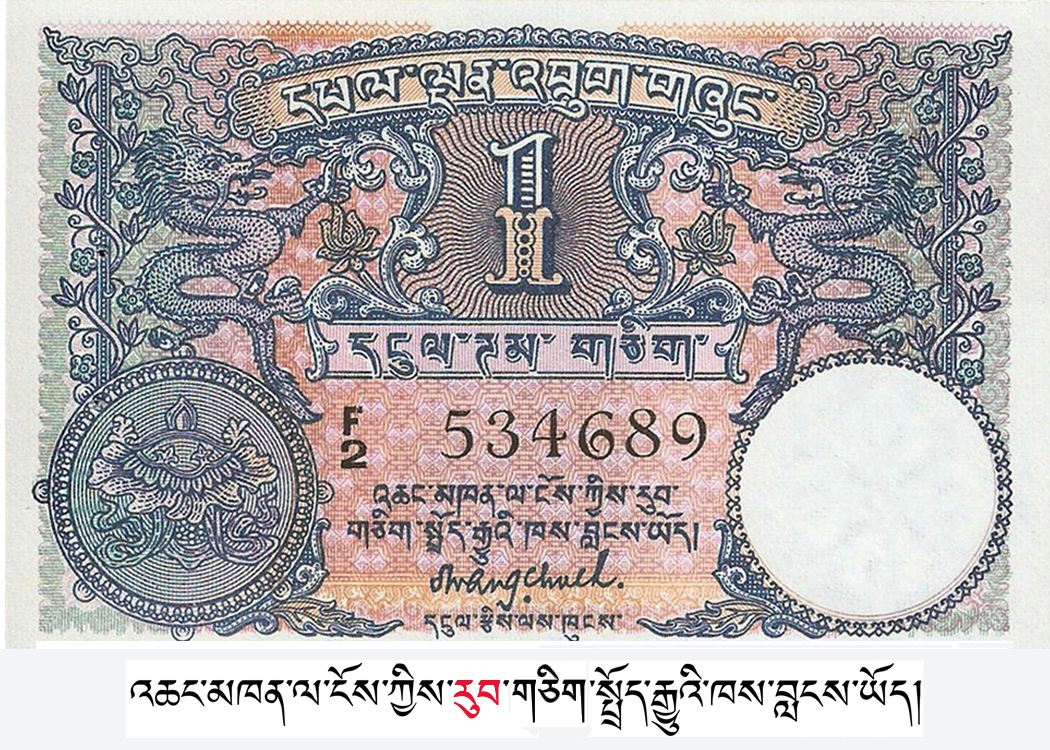
While I was racking my brains between why and what, I am made aware of a German Tibetologist and coin collector - David Hollar - writing about a misspelling that he discovered in our Nu.10 banknote of 1981. I am hugely intrigued - thus I decide to run through the entire gamut of our banknotes - from the earliest ones issued in 1974 to the present day. That is when my attention was drawn to something that I had never before noticed - the use of the term “Rup” on the obverse of four of our earliest banknotes: Nu.1, Nu.5, Nu.10 and Nu.100.00. The scripting of the PROMISE TO PAY is worded as follows:


I am referring to our following earliest four banknotes issued in 1974 and 1975:


What the dang hell is "Rup"? Is it Rupee like the term used on our Nickel Tikchang of 1966? I consulted a Bhutanese scholar but he totally disagreed …. he opined that it could very well mean “Tikrup”. I asked another respected scholar and he told me the same - that the term “Rup” is short for “Tikrup” - that the term "Tikrup" or "Tiru" has been in use in Bhutan from ancient times - to mean: money. He went on to say that the oldest written record of the term he has come across so far appears in the Namthar (biography) of Yoenten Thaye who was our 13th Je Khenpo - from the year 1771 to 1775.

This was most revealing! How could I have missed it? When I think of it, even today the use of the term "Tikrup" or "Tiru" is more common, while “Ngueltang” is only occasionally used, if at all. For instance, if one were to listen to a conversation between a seller and a buyer in the market place, in all probability one will most likely hear the use of the term "Tiru", rather than "Ngueltang". In all likelihood, they are more likely to exchange the value of a merchandize in the amount of "Tiru" - rather than Ngueltang.

Listen carefully and in 90% of the cases you will hear it said:

Tiru Nga - instead of Ngueltang Nga!

I can bet that a Khengpa will most likely say: “Tiru khai thek bi-yai”

On the other hand a Ngalong is unlikely to say: “Ngueltang khae nga gobey"

A Sharchop will most assuredly say: "Sharchokpa baka bu tiru cha na om la"

Saturday, June 1, 2024

Three Centuries Of Errors …… and Counting!

Recently a coin collector and Tibetologist from Germany - David Holler - noticed a spelling mistake in our 1981 Nu.10 banknote and wrote as follows:

Bhutan: Spelling mistake on banknote
In the Tibetan script of the 10 Ngultrum banknote from 1981 (P8) there is a misspelling in the promise to pay.

David Holler is referring to our following second-generation Nu.10 banknote issued by the Royal Government of Bhutan but signed by the then Deputy Managing Director Mr. Yeshey Dorji of the Bank of Bhutan.

Thankfully, in the third generation of the Nu.10 banknote, signed by the then Chairman of the Royal Monetary Authority of Bhutan – HRH Ashi S C Wangchuck, His Majesty’s Representative in the Ministry of Finance, the Promise to Pay was correctly worded as follows:

But what Mr. Holler seems to have missed out is the uncommon manner in which the Promissory Note is worded, as follows:
A word for word English translation of the above Promissory Note would read as follows:

Promise is hereby made to pay the bearer a sum of the face value of Ngultrum 10

It would appear that Mr. Hollar omitted to pointed out the mistake contained in the country's first Nu.10 banknote, as follows:
The banknote bears the signature of HRH Ashi S C Wangchuck, His Majesty's Representative in the Ministry of Finance but the organization on whose behalf she signs is designated the Department of Finance, as follows:
The organization should have rightfully been named the Ministry of Finance, as follows:
The above errors are minor design flaws – what is truly shameful is the manner in which we have spelt the word: NGULTRUM. It should have been correctly spelt as: NGUELTANG:

Nguel = Silver
Tang = Coin

That being said, calling our paper currency “Ngultrum” or even “Ngueltang” would be totally incorrect - because our banknotes are neither silver, nor coin. Regardless, if I were to choose between the two words, I would opt for the word “Ngueltang” since it has the backing of the legitimacy of history behind it - the history behind the emergence of one of the three earliest of our monies - our metal currency. It is too lengthy to deal with the subject here - I will do so in my book, when it is eventually released.

Another discrepancy: History records that the term “Ngultrum/Ngueltang” was coined when we issued our paper currency for the first time in 1974. But the country’s earliest Postage Stamp issued in 1962 is proof that the term was in existence more than a decade earlier, if not more. The following is the history of the morphology of the term:


To be fair, perhaps it is in our genes to commit errors – and allow it to perpetuate for centuries thereafter. Look at one of the following earliest of our metal currencies. Of the nine alphabets hammered on it, most likely sometime during the late 1700s, eight of them are foreign alphabets. Only one: SA is our own.


In a number of cases, the coins’ dies were wrongly engraved – resulting in the following coin’s alphabet “SA” being rendered in a mirrored state:
A large number of coins were over-struck, as follows:
Even our earliest milled silver coins were not without problems. Look at the following Silver Thala of 1929/1930. The word “Druk” is wrongly rendered while the date of minting was depicted wrongly – as “Sa Druk Lo” while the actual striking took place during “Sa Drue Lo”.
An erroneous issue of our 1950 Tikchang is considered one of Bhutan’s rarest coins – for the reason that it was struck with the wrong date of “Sa Druk Lo”. The Calcutta GoI Mint where the coins were minted, had mistakenly used the wrong die - the correct die should have been the one with the year of minting marked “Chaag Taag Lo”. The mistake was detected and the minting of the coin was hastily halted.
Of all the calamitous errors, the following coin of 1966 is the most deplorable - you can see the reason why:
The above is the coin for the reason for which my coin book will stop at 1955.

Friday, April 19, 2024

The Era Of RUBBING!

This morning I was treated to a mail dating back to mid-1973. Attached to that mail, typed on a plain white paper with manual mechanical typewriter, was an image of a Bhutanese copper Maartang dating back to late 1800 - early 1900. I think the Indian collector - since dead - then based in Kalimpong, India was hoping to sell the coin to some Western collectors of Bhutanese coins.

I was truly tickled, in the manner the image of the coin was reproduced - it was replicated on plain white paper by the process of RUBBING. Imagine!! There were no photocopies, scanners or even mobile phones or affordable camera to capture the image ---- people had to resort to vigorous rubbing of the coins to reproduce an acceptable image of the coins they wanted to show to interested collectors located across the seven seas. These days we have all sorts of devices to capture an image - in a flash of a second.

The following is the rubbing of the Bhutanese Copper Maartang that was sent to a collector based in Europe, by AIR MAIL, on 16th May, 1973 - more than half a century back:

Image of the coin produced by rubbing of the coins obverse and reverse - image made in May of 1973

The following is the image of the same exact copper Maartang that is in my collection - captured with Canon’s professional class digital camera model EOS-1Ds Mark III, that can churn out images at a whooping 21.1 megapixel!

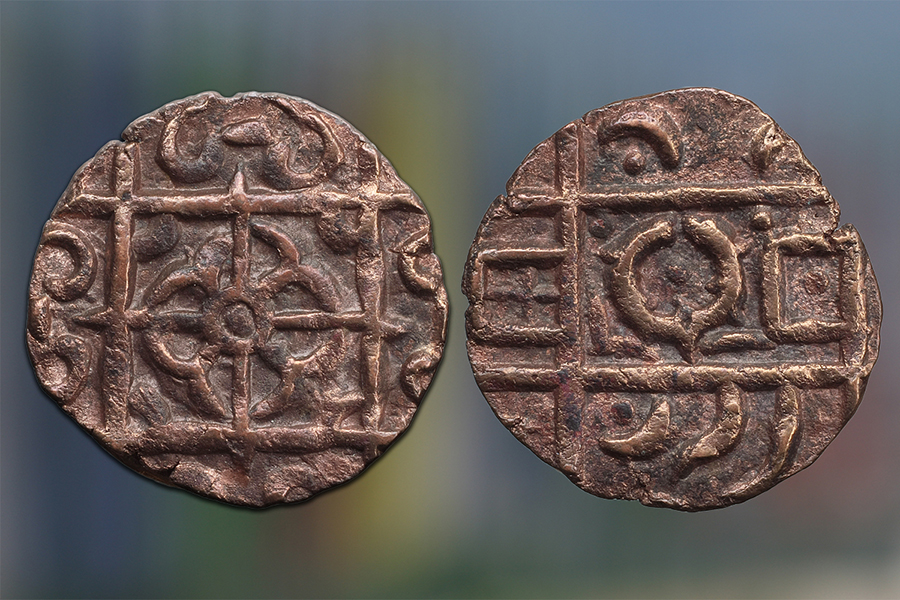
Image of the same Copper Maartang, digitally captured, in August 21, 2017

The above coin will be included in my upcoming coin book - it will be one among a group of 15 copper coins labeled Ser Nya Maartang - after the pair of Gold Fish depicted on the coin’s obverse side.