Showing posts with label Ham Radio. Show all posts

Tuesday, March 17, 2026

The Most Dependable Communications System During Calamities

For years now I have been encouraging the RGoB to consider training a select group of DeSuups – to act as an Emergency Response Group (ERG) - in the use and operation of Ham Radio or Amateur Radio – a form of wireless communications that will still be standing even as everything else around it falls and crumbles like 9 pins. But no one has as yet stopped to consider the idea. Well, what can I say – I suppose, true to character, it is because it is no money in their pockets.


Highly portable Ham Radio Transceiver with Microphone

But at a time when natural calamities are becoming more and more common place – it is important to be prepared for the most unexpected eventualities. In times of emergencies we all know that being able to communicate is most critical.

What if our mobile network goes down? What if we are rendered incommunicado with the outside world? What if we cannot communicate within our own boundaries? Such situations can arise – the world as we know it now has become a dangerous and unpredictable place to live in.

In times of natural disasters and emergencies and when every form of telecommunication fails, Ham Radio is the only means of communication that will still work and come to the rescue of relief workers. It can operate from the middle of the ocean or from atop Mount Everest. It can be set up and become operational in minutes. At any given time, more than a hundred thousand Hams (also known as amateurs) are active and listening in on to the radio signals around the globe. Ham Radio is perhaps the only multi-modal communication system that can transmit and receive voice, text, morse code, graphics and image data over the open airwaves. And, best of all, there is no charges to be paid to any service providers. It is all FREE!

Many people over the years have used the Ham Radio for a variety of purposes and emergencies but one of the most famous among them is the case of Chogyal Palden Thondup Namgyal, the last Monarch of the Kingdom of Sikkim. When everything else around him was gagged up, his private Ham Radio equipment installed in his palace was the only means through which he managed to send out his message of crisis. A little after 6 PM on 9th April, 1975 – he used his Ham Radio equipment to send out his distress call – to inform the world of the annexation of his Kingdom.


Some of the world luminaries who are registered Ham Radio operators with individual and unique CallSigns assigned to them.

Ham Radio can effectively serve as our short-term emergency back-up communications system – it can transmit to every corner of the earth. And, best of all, it is easy to master, simple to operate, equipment are cheap to acquire, and best of all, compact and highly mobile.

Saturday, December 20, 2025

Unauthorized/Illegal Amateur Call from A5

Hi Bernie,

Good Morning ....

I am happy to let you know that I finally got around to talk to the person in the Spectrum & Technology Division of the BICMA (Bhutan InfoComm and Media Authority) the Regulatory Authority of the Royal Government of Bhutan who oversees all matters related to Ham/Amateur Radio operations from Bhutan. As I had anticipated, the person confirms to me that the Authority has NOT ISSUED the CallSign A50A to any one in recent times, nor ever before. Thus, he thinks that it is an illegal and unauthorized operation, without their knowledge or permission. So, in my understanding, if the call has been on the air from Bhutan .... it should be considered UNAUTHORIZED and ILLEGAL….. and if any QSL’s were issued/confirmed acknowledging the Call A50A, they should be null and void. May be it is wise to inform your members/readers - perhaps even notify the worldwide amateurs - through the ARRL.

Unauthorized amateur radio call from Bhutan (A5)

Further, for your information, according to the official records of the BICMA, I am informed that the only Calls issued so far with the prefix A50 are the following:

A50DT            GovTech, Thimphu - a technology agency established by the Royal Government of Bhutan
A50JNEC       A technical institute run by the Royal Government, Deothang
A50CST          A technical institute of the Royal Government, Phuentsholing
A50CST2        A technical institute of the Royal Government, Phuentsholing

It is possible that an inexperienced amateur from one of the above QTH could be sending out calls without using the full CallSign .... I have requested the person In-Charge at the BICMA to call up each of the above QTH and remind the operators of the proper protocol when they come on air using A5 CallSigns. 

For your information and record, in addition to the above, the following unique Calls were issued by the Royal Government of Bhutan, in appreciation of their contribution to the development of amateur/Ham radio in Bhutan:

A51A          Yasuo Miyazawa (ZORO), Japan .... since silent key
A51B          Dr. Glenn Johnson, USA

I hope this helps.

Thank You very much for contacting me with the information.

73!

Yeshey Dorji
A51AA

Sunday, October 22, 2023

Alpha Five Two Alpha Alpha Live from Bhutan

After struggling for two days - the struggle is still on - HAM Operator Abie Alexander from the USA who has been allocated the visitor's local CallSign of A52AA is now on air from Jambayang Hotel in Thimphu. He is still experiencing massive interference - it is yet to be established whether it is a man-made one or it a solar activity that is causing such severe interference. We think it is electrical noise - caused by some unknown electrical activity - but that is a wild guess.


Today we are going to try something that hopefully will confirm or eliminate the possibility that the noise is caused by radiation generated by electrical activity .... 

Recording of a live QSO between A52AA from Bhutan and a VU2JFA from India.

Something tells me that it is electrical activity that is the cause of this unusually powerful interference. If I am right, I have to wonder what unknown operation is underway in and around Thimphu Municipal area and its periphery that is the cause of such massive electrical radiation? There are no radars installed atop our mountains ... so what is that that is pulsating and throbbing at such a monumental scale? Damn .... !

So far the A52AA station has made connection with Japan, Russia, India, Bangladesh, Uruguay, Brazil and few other countries ..... He hopes to cover many more countries during the remaining days of his operation from Bhutan.

I wish him BEST OF LUCK!

Friday, October 20, 2023

CQ …. CQ …. CQ …. A52AA Calling from the Land of the Thunder Dragon, Come in….

Beginning this morning, a HAM Radio operator from the US of A will start broadcasting SSB HAM Radio voice signals from Jambayang Hotel in Thimphu. He is provably the first HAM Radio operator to operate from Bhutan - after the legendary “ZORO” - Mr. Yasuo Miyazawa of Japan went “Silent Key” in March of 2022. Zoro maintained a permanent Ham Radio Shack at the Royal Thimphu College from where he operated Ham Radio to the delight of Hams around the world, whenever he was in Bhutan.

A52AA arrives Bhutan and begin operations as of today


A SAARC HAM Radio Member operator based in Guwahati, India announces to the world the arrival in Bhutan and operation of HAM Radio by A52AA


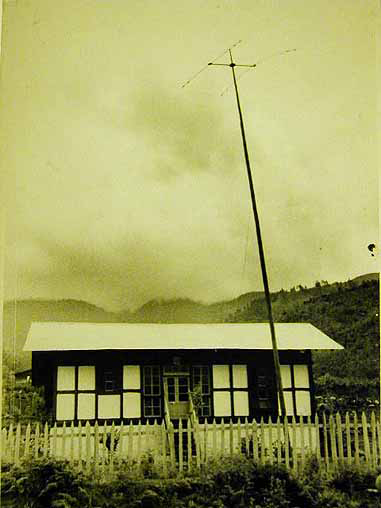
Bhutan’s first HAM Radio Shack - called a QTH in HAM parlance. It was located at Wirelesspang, above Dechenchholing Palace. It became operational in 1954-55. For the first time Bhutan sent out HAM radio signals in 1954 from a place called Rida in Wangduephodrang. The operator was N. Chawna, a wireless instructor in the employ of the Royal Government of Bhutan.

Ham Radio is a form of wireless communications that is so versatile and efficient that one can operate it from the top of Mount Everest - or the middle of Atlantic/Pacific Ocean. It is one communications system that will never go down - when every other communications is down. It is a critical communications mode and system that is first to report world’s most devastating calamities, from the remotest of locations. In times of emergencies, this is the communications of choice - without parallel.

When every form and method of communications was blocked and disbanded, His Majesty Palden Thondup Namgyal, 12th and last Chhogyel of Sikkim used HAM Radio communications system that was installed inside his Palace, to inform the world community that his Kingdom was being besieged by India, in 1975.


I have been trying to get Bhutan to train people in the use of this mode of communications. This is critically important for us - given our land-locked geographical positioning. Sadly, no one is interested.

Saturday, March 26, 2022

The Famous Zoro is Silent Key

I am saddened to read of the sad demise of Mr. Yasuo Miyazawa of Japan. May he rest in peace - I offer my condolences to his family and pray that they have the strength to bear the loss of a man who was a trailblazer in the strictest sense of the word.

The following KUELSEL report presents only one part of his engagement with Bhutan. What few Bhutanese are unaware of is the other side of him – that which binds him to Bhutan forever.
Mr. Yasuo Miyazawa of Japan, Mr. Jim Smith of Australia and Dr. Glenn Johnson of the US have their places in the modern history of Bhutan – particularly in the wireless communications area. Three of them helped Bhutan get back on the amateur radio airwaves – after being silent for decades as of early 70’s.

After close to 30 years of being inactive, Mr. Jim Smith of Australia convinced late Dasho Thuji Yonten, erstwhile Director of Wireless, to come back on the ham radio airwaves – Dasho Yonten went live on 27th of April, 2000. It was a world event – reported by DX News Network, on 29th April, 2000, as follows:

“The second happy news is that Yonten, A51TY has been back on the air since 27 April at 12.01 UTC. He made his first CW (with RW0JR) and SSB (with VK9NL) QSOs on 20 metres”.

Dr. Glenn Johson, an American Orthopedic surgeon and my friend conducted the first ITU certified/designated Ham Radio training course for 7 Bhutanese operators – of which I was one. Upon passing the exams at the end of one-month course I was issued my CallSign A51AA. In recognition of his service to Bhutan, Dr. Glenn Johnson is one among two none-nationals to be issued a CallSign with a national prefix: A51B - for life.

Mr. Yasuo Miyazawa of Japan contributed close to US$100,000.00 in cash and equipment that helped restart ham radio activity in Bhutan. Four Bhutanese (I was one among them) were invited to visit Mr. Miyazawa at his home in Japan – to receive the donation.

Me posing in front of Tokyo Hyatt Regency when I went to Japan to receive the donations from Zoro

He is the other person who has the distinction of being issued a CallSign with national prefix – A51. He was issued the unique CallSign A51A that he was free to use for life – anytime he wished to operate from within Bhutan.

I am given to understand that Mr. Miyazawa maintained a Ham Shack at the Royal Thimphu College from where he operated whenever he was in Bhutan.

Mr. Miyazawa is famous around the world particularly in the global ham radio circle where he is affectionately known as “ZORO” - a fictional Japanese character in One Piece franchise created by Eiichiro Oda. Zoro is depicted as an expert of Santoryu (Three Sword Style).

I cannot be certain but I think Mr. Miyazawa was nicknamed “Zoro” for his dare-devilry.

I am not sure how far it is true – but rumor has it that Zoro had to go underground for close to ten years - after he was caught donating almost a shipload of merchandize – free to the North Korean regime. The reason for his donation to the “forbidden land”? – the permission to operate ham radio from that country where it was banned and not a single radio amateur in the world had a QSO from that country – until Zoro started to send out signals from that country, upon gaining permission to operate from North Korea, made possible by his massive donation.

Because he was underground I had a huge problem trying to locate him. But I finally did – through his Personal Secretary – whose contact details were provided to me by one of his staff working at his Research Center in the North Pole.

He was a generous man. A Japanese guest attending the dinner that Mr. Zoro had hosted in our honor, was shocked that he served bucketful of Matsutake Mushrooms (Sangey Shamu) during the dinner. The person informed me that the mushroom was so expensive that most Japanese could not afford to eat them. Should they received one as a New Year Gift – they passed it on to another family as their gift and it went on like that from family to family.

Talking of ham radio, I have been trying to promote its use in Bhutan. I tried with the Disaster Management people – no go. I tried with the DeSuung organization – the suggestion is still in a state of limbo. But ham radio is the only communications method that will be standing – when every other form of communications go down, including electricity. You can operate/broadcast it from atop the Mt. Everest or from the middle of the boundless ocean.

Supposedly this was the Ham Radio Shack - called a QTH in ham parlance - from where Bhutan started to broadcast ham radio signals - as early as 1955 - first by N. Chawna and then by S. Saja and by the American Gus Browning and finally by Dasho Thuji Yonten in 1972, including by a civil wireless operator by the name of H. N. Pradhan of Samtse. This wireless station was located at Wirelesspang - above Dechenchholing Palace - one cannot fail to notice the wireless antenna in front of the Shack.
For the first time Bhutan went on the ham radio airwaves in 1954 - from a place called Rida in Wangduephodrang. The wireless set was operated by N. Chawna, a wireless instructor, who accompanied His Majesty the Third King during his tour of the Eastern Bhutan.

NOTE: When a ham radio operator passes away, we say he has gone "Silent Key".

Saturday, November 11, 2017

The Complicated World and Words of the DXers

This is the DXpedition report made by Steve Jones of USA who operated ham radio from Paro last month. He worked the Bhutanese airwaves under his visitor’s license with the Call Sign A52SJ. I reported his arrival and his story on this Blog on October 12, 2017.

In an age of super fast internet, the lowly wired wireless still attracts the world's most brilliant brains. I believe that the appeal has to do with the complexity of this primitive and yet most bankable mode of communications.

It is my hope that some day the DeSuung would introduce ham radio in their training curricula, so that a select group of the specialized DeSuups are skilled in ham radio communications. When every other form of communication fails, ham radio will be the only one that will stand up and communicate. It will work even from the top of Mt. Everest.

------------------------------

To all of you who helped me and/or tried to work me at A52SJ on 160 meters,

Thank you! Unfortunately I worked no US West Coast (or any US coast for that matter), but I had a blast.  Bhutan is a wonderful and fascinating place. And the people are very friendly and helpful!  Gross National Happiness is a fine line they are navigating, but so far they are maintaining their unique culture while borrowing what’s useful from Western technology. I was even able to see the area where Gus Browning operated AC2H in Wangduephodrang when I worked him there from Sacramento in 1965. There were no paved roads to the town back then.  Gus’s Hammarlund HX-50 now resides in the Bhutan National Museum in Trongsa.

My station was up and on the air about 6 hours after our Airbus 319 landed in Paro, thanks to Yeshey Dorji’s (A51AA) great team of helpers. It worked as planned and I was able to work everything I heard on 160 meters. The 1-wavelength Beverage was wonderful, dropping noise by about 10 dB when running the K3 in Diversity RX mode. Signals just popped out of the background. But “everything I heard” on 160M was all of only 9 QSOs! CW conditions were terrible. JT5DX answered my CQ the first day as soon as the sun went down, but then I heard nothing on CW for the next 2 weeks except a too-faint RL9Y and the 2nd harmonics of Chinese broadcast stations.

On FT8 I worked Asia and Europe, including PE1RNU near Amsterdam, but there seemed to be a black hole toward North America. I didn’t even hear/decode any JA’s. I did see my call decoded and reported on PSK Reporter all over the US East Coast and Midwest, but no one called me from there.  The Bhutanese would say the propagation gods were wrathful. I tend to agree.

With the Beverage I heard some signals on 80M (i.e. many JA’s) and lots of worldwide DX on 40M and above. But my Inverted L was cut for 160M and I couldn’t easily switch bands. I thought about lowering the L and cutting the wires into a dipole for 80M or 40M just to make some contacts. But it would have been very time consuming to restore the L to 160M if propagation improved, so I decided to stay on 160M and hope for an opening. If I were to do this again, I’d bring a remotely switchable tuning network to allow quick band-switching on the TX antenna. That might require a bigger suitcase! I was unable to exchange emails with you real-time as the Hotel Olathang’s WIFI was too far away from our cottage. I checked emails only when we were near the hotel lobby at breakfast or dinner, and that’s why my replies to you were typically rather untimely.

Again, thank you all for your great encouragement, and I hope to work you on 160M someday from N6SJ.

Vy 73,

Steve

N6SJ
A52SJ

Thursday, October 12, 2017

A Handful of Red Bhutanese Earth – After 52 Years

In a faraway land at the edge of the earth—a place called Sacramento, California, USA, 14 time zones away from Bhutan—a young starry-eyed novice amateur ham operator sat at his set, rotating the dial of his station. Suddenly, he chanced upon what is known in ham parlance as a “pile-up”. Incredulous and spellbound, he edged closer to make sure that he was hearing correctly what was being transmitted over the airwaves in single sideband, or SSB, mode.

There was no mistaking it! Even as he listened breathlessly, he realized that he was witness to an extremely rare ham radio event. A dream opportunity was being orchestrated right in front of his eyes—or ears. And yet, he could not participate, hampered as he was by his older, simpler continuous wave, or CW-only, radio set.

All of a sudden, through the deafening cacophony of a million SSB calls, he heard an unmistakable South Carolina drawl:

“OK boys, now let’s stand by for the Corn Whiskey (CW) station.  The Corn Whiskey station only, please, go ahead.” 

His hand trembling with excitement, the novice grabbed his telegraph key and, in a series of dits and dahs, sent out his then CallSign, WA6SVY, in CW mode: Morse Code.  The center of the universe on the receiving end acknowledged his call thus:

“WA6SVY you are five-seven-nine."

It was 29th April, 1965, 8.19 AM in Sacramento; 9.19 PM in Thimphu. The young operator was the 17-year-old novice ham, Stephen Frederick Jones. The operator on the other side of the globe was none other than the legendary American Ham radio D’Xpeditioner, Gus Browning. Gus, as he was known in the ham world, was operating from a land that fewer than 0.50% of Americans had heard of—a place called Bhutan, then considered the rarest of rare ham radio countries.

In the annals of ham radio history, it was a signal event, literally and figuratively. For the young Steve Jones, it was a windfall few amateurs around the world dare dream of: getting a QSO, or conversational contact, from the fabled Gus. Even more astonishing, Gus was operating from a ham radio Shangri-La, a mythical Himalayan Kingdom that to this day eludes most people’s geographic familiarity.


Ham Radio CallSign of Stephen Frederick Jones, as he was known as a novice operator.


QSL Card of Gus issued to Steve Jones for his contact in 1965
More than half a century of pinning to operate ham radio from Bhutan, the young novice – now a greying 69 years old First Class ham radio operator – Stephen Frederick Jones - has finally made it to Bhutan. He arrived Paro this morning - 12th October, 2017 and right away went about trying to string up his 160M wire antennae. But before he proceeded with the set up, he stooped to the ground and gathered up a handful of red Bhutanese earth and uttered; “I am finally here”.

Steve & Valerie

Mr. Stephen Frederick Jones started to send out his radio signals to the world hams – beginning this evening. He will operate until the night of 18th October. To honor the legendary Gus, Steve has named his DXpedition “Gus Browning Memorial DXpedition” (http://www.arrl.org/news/gus-browning-memorial-dxpedition-offers-opportunity-to-work-bhutan-on-top-band).

Sunday, July 5, 2015

Bhutan's First QSL Card

It is called wireless and yet, no other communications device uses as much wire, as does the wireless transmitter/transceiver! Even the ground on which the antenna is hoisted is strewn with copper wires running to all directions - for better signal reception.

 The "wirelessness" inside a Ham Radio Shack containing radio sets and other paraphernalia

Bhutan started to take its baby steps towards modernization sometime towards the end of 1950's, and yet, by 1955, someone in Bhutan was already sending voice and data over the airwaves - exactly 60 years ago! A wireless instructor in the employ of the Royal Government of Bhutan by the name of N. Chhawna from the Indian State of Mizoram was happily communicating with people as far away as USA - in 1955, using wireless radio equipment.

Records available in various archives confirm that the following were two of Chhawna’s and, by default, Bhutan’s earliest QSO’s. The top one is a QSL Card logged with an amateur with the CallSign VS2BD - Edward B. Powell - operating from the erstwhile Federation of Malaya that ceased to exist as a country as of 15th September, 1963. Like Malaya, Sikkim was deleted from the countries’ list as of April 30, 1975 and Tibet saw its demise as of May 30, 1974.

Two of Bhutan's first QSL Cards

 The Card at the lower end was logged with an American ham radio operator using the CallSign W8PQQ - his name was Albert H. Hix from Charleston, West Virginia, USA. This Mr. Hix was an enigma in ham radio. This really ancient ham radio operator logged his first QSO on November 9, 1935. His very last QSO was on June 10, 2003 - meaning he remained active on the radio for 68 years! Upon his death on 25th June, 2003, he had accumulated 10 footlockers filled with close to 135,000 QSL Cards! This is an incredible average of almost 6 Cards every single day of his life as a radio operator!

The earliest recorded ham radio operation from Bhutan by a Chilip is credited to Mr. Gus Browning of USA. He is supposed to have first operated from Bhutan in July of 1963. He writes that he was back in Bhutan again in February - April, 1965. Frankly, there are so many inconsistencies in his operations; supposedly made from Bhutan, that I am not quite sure they are all true.

 Gus Browning with his wife and daughter

His wife Peggy writes that she too was here in Bhutan with her husband in 1965 and worked for a while at the Hospital in Langjopakha. I have been showing Peggy’s photo to people who worked at that old hospital of the 60’s - to see if they recognized her. No luck yet. My own aunty was a nurse during that time at the hospital across the Tashichoe Dzong’s cantilever bridge - but she says her memory fails her.

 Mrs. Peggy Browning, Gus Browning's wife photographed around the time she was supposed to have visited Bhutan

NOTE:
QSO : When two radio operators (hams) establishes radio contact, such a contact is called a QSO;

QSL : A written confirmation is required, to validate a radio contact between two operators.
           Such a written and signed confirmation, in the form of a printed Card, containing full details
           of the contact, is called a QSL.

Tuesday, January 31, 2012

CQ .... CQ .... Alpha Five One Yankee Doodle Calling .... CQ ... CQ

“CQ” is a ham radio or amateur radio Code. When I call out “CQ, CQ” over my radio, I am inviting any ham radio operators listening in on the active frequency to respond to my call. “Alpha Five One Yankee Doodle” is supposed to be my unique amateur radio CallSign which will be recognized by amateurs around the world listening in on my call that I am an operator from Bhutan. In truth, my national CallSign is Alpha Five One Alpha Alpha (A51AA). I am using Alpha Five One Yankee Doodle (A51YD) since this is not a call made over the radio waves. Actually, if I was on air, I would be committing an act of piracy since the CallSign A51YD is already allocated to someone else. Under the amateur radio Code of Ethics and Conduct, it is a serious offence to use someone else's CallSign.

As some of you may have guessed, “Yankee Doodle” stands for my initials: YD. The international community recognizes "A5" as Bhutan’s country prefix and the number “1” after the A5 indicates that I am a national operator: under the BICMA amateur radio CallSign allocation conventions. Visiting Hams will be allocated a temporary national radio CallSign consisting of their 2-alphabet initials of choice, preceded by the alphanumeric "A52".

Now, the reason for this CQ: I am sending out this amateur radio code today in fulfillment of the commitment I made to some of you readers - to allow you a live demonstration of how an amateur radio operator operates. I would like to announce to all those to whom this may be of interest - that an English/British Ham will be operating from Paro as of the 11th February, 2012. He will remain on air until the night of 16th February, 2011.

Anyone interested to observe the proceedings is welcome to visit the ham shack in Paro. I will set aside a day - any one day that is convenient to you: between 11-16th February, 2012. Please let me know if you are interested and which date would suite you. Please note that it would be unfair to distract the ham operator beyond one or two hours. I think 12th February would be a good day since it falls on a Sunday.

Please mail me at: yesheydorji@gmail.com. Lunch is on me - after the demo and a chit chat with the operator who is visiting Bhutan for the first time – specifically for ham radio operation.

Saturday, November 19, 2011

My Answer To: PaSsu/Sangay/Penstar

To be qualified as a Ham and in order that you can be authorized to use a wireless transceiver, you need to pass an examination conducted by a qualified Ham under the aegis of the BICMA (Bhutan InfoCom and Media Authority, Ministry of Communications, Royal Government of Bhutan). Although BICMA is the regulatory authority that will issue you the licence and the call sign, I am afraid that they do not have a trained Ham who is capable to impart training or conduct examinations. 

You need to be knowledgeable in subjects such as ITU’s (International Telecommunications Union) and our own laws governing telecommunications, amateur radio etiquette and, at the least, 5 WPM (5 words per minute) Morse code capability. Although Morse code around the world is no longer a necessity, BICMA’s rules still require you to pass the test in Morse code. 

So, if you are interested to go into Ham radio, you first need to learn all the above and then request the BICMA to conduct the exams for you. However, as I said, they don’t have that capability in-house … so they will have to call in someone from outside - closest being from India. They may be willing to do that for you - provided you pay the expenses for the examiner to come to Bhutan and conduct the exams. 

If you are really serious and if you are willing to wait until July, 2013, there is someone (of the highest class) coming to Bhutan during that time and will be in Bhutan for over a month. Let me know. I will be happy to request the person to arrange a training for you as well as anyone else interested, so that you can study for the examination which he will conduct under the authority of the BICMA. If you pass, you will get your licnece. Without a licence, it is illegal to operate a wireless set. 

Regarding the equipment … all that you need is a transceiver, mike, keyer and a simple antennae to start with. The cost really depends on the type of equipment you want. It can start anywhere from US$ 300.00 for the complete set to all the way to US$500,000.00 which would include Yagi beams and powerful Amps and top-of-the-range transceivers and a gamut of other paraphernalia. If you don’t have the money for the set, I can help by lending you mine - I have about 7 full sets. But without first making sure that you have a licence to operate the wirless sets, I will claw out your eyeballs - if you even so much as look at them :)- Wireless equipment in the hands of irresponsible people can be a very, very dangerous tool! 

Once you are on the air, if you have the time, you can have a blast. You will make friends around the world - from Kings to astronauts to doctors to inventors to lawyers to pirates in the Caribbean. There is only one danger – your wife might throw you out into the street from time to time since wireless transmission causes serious disruption in the reception of TV signals :)

Friday, November 18, 2011

AC3PT - King Palden Thondup Namgyal, Chogyal Of Sikkim (sk)

Three of my readers - Passu, Sangay and Penstar - who read my last post titled "Wireless Full of Wires" and wanted to know more about the distress call sent out by the late Palden Thondup Namgyal, Chogyal of Sikkim, over his Ham radio. Instead of responding to them in the form of a comment, I would like to post my reply as a separate post, so that others may get to read it. Here it is:

I bet that there were others around the world who heard Palden Thondup Namgyal, Chogyal of Sikkim when he sent out that distress call. But I know of only one person who exchanged words with him on that fateful day. His name was: Horst Geerken, a telecommunications engineer working for the German firm Telefunken. At that time, he was based in Jakarta, Indonesia.

Although the Chogyal’s radio was silenced shortly thereafter by the invading forces, a friend of Horst Geerken was listening in on the conversation taking place between the Chogyal and Geerken. He was a Swedish journalist. He informed the press agencies in Sweden, Indonesia, Germany and Singapore. The next day the papers in those countries released the news of Sikkim’s annexation.

Two years after the annexation of Sikkim, Chogyal Palden Thondup Namgyal sent a letter of thanks to Geerkin - thanking him for his help during his moment of distress. The King wrote that his radio equipment was taken away from him. His Majesty Palden Thondup Namgyal invited Geerken to his Palace in Sikkim, provided that the Indian authorities gave him permission.

Geerken tried three times to enter Sikkim to meet the Chogyal - all three times he was refused permission. Finally, after twenty years of the demise of the Chogyal, Geerken managed to visit Sikkim in 2002. By than the radio antenna that must have been strung over the Palace roofs which helped him to put out the distress call on the 9th April, 1975, were no more.

For the first time and the last time, I saw His Majesty Palden Thondup Namgyal, the Chogyal of Sikkim, during the coronation of His Majesty the IVth Druk Gyalpo in June, 1974. I was then 18 years old. I was on coronation duty at the Motithang Hotel - I manned the Bank of Bhutan’s cash counter installed at the hotel - to cater to the local currency needs of the visiting dignitaries to the coronation.

Less than a year later, in April of 1975, Palden Thondup Namgyal was put under house arrest and his Kingdom taken away from him. He went Silent Key on 29th January, 1982 in New York, USA. He died of cancer.

Wednesday, November 16, 2011

Wireless Full Of Wires

What is that thing that is oval in shape and is surrounded by hair?

You dirty pig, I am not answering that question.

What? What is dirty about it? It is an oval-shaped pond in the middle of a park and it is surrounded by lush green grass and flowers.

Oh OK. I didn’t think of that :)

So, once again, what did you say was that thing that is oval in shape and is surrounded by hair?

Simple - it is an oval-shaped pond in the middle of a park and it is surrounded by lush green grass and flowers.

No, No, No! It is that which you thought earlier.

That was a joke told to me by a friend with whom I was travelling in a bus from Siliguri to Calcutta. One of the Skylab space stations launched and operated by NASA had disintegrated and was hurtling towards earth. No one knew where it would land. Governments around the world ordered the grounding of train and airplane services. Thus, I had to take the Rocket bus from Siliguri to Calcutta where I was then posted.

The above joke reminded me of something that is not a joke. In fact it is something dead serious. So let me ask you the questions:

What is that thing that is called wireless but is full of wires?

What is that thing that comes to life when everything else is dead?

What is that thing that a King used to send out international distress calls, even as his Kingdom was being attacked and taken over by an invading power?

When the irritatingly pesky cellular network fails, when the internet is down and when the telephone system is bust, when the TV and the radio broadcasts are silenced, what is that thing that you can use to communicate freely and boundlessly - all the way to the South Pole and the North Pole and to all the Poles in between?

What is that means of communication that requires no set destination, no pre-determined recipient, no numbers and can be broadcast to few million people around the world?

In an era of super wide and fast bandwidth, in the age of super fast satellite communications, what is that primitive form of communication that still enthrall and attract passionate interest from the very best brains such as inventors, doctors, scientists, astronauts and engineers?

The answer to all that is: Ham Radio or Amateur Radio.

In times of natural disasters and emergencies and when every form of telecommunication fails, ham radio is the only means of communication that will still work and come to the rescue of relief workers. It can operate from the middle of the ocean or from the top of the Mount Everest. It can be set up and become operational in minutes. At any given time, close to four million users are active and listening in on to the radio signals around the world. Ham radio is perhaps the only multi-modal communication system that can transmit and receive Voice, Text, Morse Code, Graphics and Image data over the open airwaves. And, best of all, there is no charges to be paid to any service providers. It is all FREE!

Many people over the years have used the Ham Radio for a variety of purposes and emergencies but one of the most famous among them is the case of Chogyal Palden Thondup Namgyal, the last King of Sikkim. A little after 6 PM on 9th April, 1975, he sent out the following distress call using his Ham radio equipment:

“Mayday! Mayday! Alpha Charlie Three Papa Tango calling. I am the Chogyal of Sikkim, my name is Palden Thondup Namgyal. Please tell the world that my country is being attacked and taken over by Indian troops. There is fighting in my Palace. Some members of my Palace guard have already been killed. All telephone and communication lines have been cut off by the Indians. I have only got my amateur radio equipment to call attention to this. India wishes to keep this annexation secret as long as possible and to invent a cover-up story. Please help me by telling the world”.

From that day on, Sikkim ceased to exist as a nation.

Amateur radio employs the use of wireless transceivers (all modern wireless sets are transceivers - device that is a combination of a transmitter and a receiver). It is the earliest form of telecommunications invented by men. And yet, look at the list of luminaries who are the users of this primitive form of communication:

AC3PT     King Palden Thondup Namgyal, Chogyal of Sikkim (sk)
HS1A       King Bhumiphol Adulayadej - King of Thailand
JY1           King Hussain of Jordan (sk)
CN8MH    King Hassan II - King of Morocco (sk)
EA0JC       King Carlos of Spain
A4XAA     King Qabus Bib Said, Sultan of Oman
SU1VN      Prince Talal of Saudi Arabia
VU2RG      Rajiv Gandhi, Prime Minister of India (sk)
JI1KIT        Keizo Obuchi - Japanese Prime Minister
UA1LO      Yuri Gagarin - First man in space (sk)
N5YYV      Kathryn Dwyer Sullivan Ph.D. NASA astronaut.
    First American woman to walk in space in 1984
GB1MIR     Helen Sharman - First British woman into space
KG6FZX     Dennis Tito - First space tourist
NY6YOS     Priscilla Presley – Ex-wife of Elvis Presley
FO5GJ         Marlon Brando, Actor (sk)
A51AA        Yeshey Dorji, Bhutan  :)-

Some pecularities about Ham aadio:
In Ham radio parlance, “SK” stands for “Silent Key” - meaning that the Ham operator is dead.

A lady Ham may be 100 years old, but she is always referred to as “YL” – meaning “Young Lady”. Likewise, a 12 year old male operator is addressed as “OM” which stands for “Old Man”.

The Hams may not speak English and yet, the medium of conversation is ENGLISH - they all converse in English when they communicate with each other over the radio.

A Ham may be stone deaf and you are likely to develop tonsillitis shouting at the top of your voice trying to converse with him/her and yet, he/she will hear the faintest of the crackle and squeak of radio signals emanating out of his wireless set.

The population figures for Hams around the world are as follows:

Japan      1,296,059          First place
USA          679,864          Second place
Bhutan                 7          Possibly, the last place

Bhutan at 7 Hams may rank as the country with the lowest number of Hams, but it is possible that North Korea may not have even one since, in the Ham world, North Korea is ranked as the rarest in the world. The reason is that there is no Ham radio operating out of that country. Until the year 2000, Bhutan was ranked at #2 but our ranking has been sliding since we legalized Ham radio usage under an Act in 1999.

Bhutan’s legally licneced Hams are as follows:

A51YL          Ambika Gurung
A51UD          Dorji Yeshey
A51KC          Kesang Namgyel (sk)
A51PK          Parop Kinley Dorji
A51PR          Pema Rinzin
A51WD        Wangpo Dorji
A51AA         Yeshey Dorji

Three of the earliest ladies who operated ham radio from Bhutan are:

A52FH          Ms Thierry Veuve Le Cleach       French
A52VJ           Ms Vivien Johnson                     American
A52YL          Ms Melissa Johnson                    American

The youngest ham to ever operate from Bhutan is Paul Johnson (W0PJ) from USA – he was 13 years of age in 2000-2001 when he operated from Bhutan. He used the Call Sign A52PJ.

The oldest Ham to operate from Bhutan was: Ms Thierry Veuve Le Cleach (F6HWU) - a French national. She was born in 1924. She operated from Bhutan in the year 2000. She was then over 76 years old!! She operated under the group Callsign: A52FH.

A Call Sign with the pre-fix “A51” is issued only to national amateurs. However, there are two none-Bhutanese persons who have been accorded the rare honour of having been issued Call Signs with a national prefix. They have been honored for their contribution to the development of Ham Radio activity in the Kingdom of Bhutan. They are:

Yasuo Miyazawa, Japan             A51A
Glenn Johnson, USA                  A51B

Official records show that the first ever Ham radio call that was sent out from Bhutan was in the year 1955 - from Rida in Wangduephodrang.

The first western operator to operate from Bhutan was Mr. Gus Browning - a legendary Ham from USA.

Bhutan was first listed in the original pre-war ARRL, DXCC Countries list - published in 1937. However, due to lack of Ham radio activity, it appears that a country pre-fix was not allocated to Bhutan. In a letter dated 1972, the then Director of Bhutan Wireless writes that Bhutan has been allocated a country pre-fix - exact date when it was done in not known but it is safe to assume that it was an outcome of Bhutan joining the UN system in 1971.

It is rumoured that His Majesty the Third King of Bhutan kept himself abreast of world news - a Ham operator in New Delhi Embassy Morse-coded the entire day’s issue of the newspaper of his choice - a near impossible job!