Saturday, October 31, 2020

King of Fresh Water Game Fishing

Feast your eyes on the following monster of a fish - called the Golden Mahseer (Tor putitora) - regarded as the king of fresh water game fishing. My own records of this fish are: 27 KGs in Tingtibi, 23 KGs in Sheytikharey, Kalikhola, 19 KGs in Harachhu, Wangdue, 15 KGs in Burichhu, Tsirang and 13 KGs in Piping, Chhukha.


The above fish was caught day-before-yesterday at Changchey, Tsirang. I have no idea what it weighed - but my guess is it would weigh about 20 KGs minimum. If you happen to hook this fish near a rush, your goose is cooked - it will drag you for close to a mile downstream. The trick ofcourse is to trick it to turn its head upstream so that it cannot make a dash against the current. If it turns its head downstream, a fish this size will most likely be not landed - you either run out of line or the fish will snap the line with sheer force of its pull. I have also known the fish to dash the lure against a boulder - in an attempt to unhook itself.

If you do manage to hook one of these beauties, I can guarantee you that the adrenaline rush would be well .... subliminal!

Mahseers are migratory fish - thus if it is still in Changchey - it can only mean that the fellow is a resident - a rarity but not uncommon. This is almost November - they should have already headed for the Bay of Bengal by now.

Sunday, October 25, 2020

BTFEC’s Grant for Waste Management

It is heart warming to read a report in the Kuensel of 22nd October, 2020 about the award of a grant of Nu.85.00 million by the Bhutan Trust Fund for Environmental Conservation (BTFEC) - for waste management programs in the country. A homegrown grant making institution being able to provide such substantial funding should be a matter of pride for all Bhutanese. I have myself been a recipient of a grant from the BTFEC, for a conservation related work.

I offer my congratulations to the BTFEC management - for their very meaningful contribution to the nation and the people of Bhutan - particularly during these difficult times. I pray that they grow from strength to strength.

The Kuensel report should have elaborated on the projects that the funding will support, so that Bhutanese people are better informed of the monumental benefit this grant will accrue to the people of Bhutan.

From what I hear, the regulatory authority – National Environment Commission (NEC) – is the implementing agency that will implement the waste management projects. Of the diverse projects that are planned and due to be implemented by the NEC, their “National Management Plan for Bio-medical and Hazardous Wastes” is of interest and relevance to me in my capacity as the Club Secretary of the Rotary Club of Thimphu. This is because we are also involved in donating bio-medical waste incinerators to the Ministry of Health. As of now, we have committed to donate 2 units of medical waste incinerators of 30 KGs per cycle capacity. Funding for another 100KGs per cycle capacity incinerator has also been assured – including the possibility of 2 more – one each from South Korea and Honolulu. But we need to proceed with caution – complete one and then go on to the next. We are unwilling to venture into multiple projects at multiple sites, while the ongoing one is still in a state of limbo.

According to Ms. Pem Zam of Ministry of Health, in one of our meetings with the Ministry of Health, she confirmed that the UNDP is donating 3 units of incinerators to the Ministry of Health – of 300 KGs per cycle capacity. From all these it is clear that Bhutan will be pretty well equipment – as far as bio-medical incinerators are concerned.

So, what are being planned to be procured under the BTFEC funding? What is the present generation of waste by the hospitals across the country, and how are the incinerators planned to be distributed and of what capacities? The following are the numbers.

WASTE GENERATION

In Bhutan, wastes are identified and categorized under two broad waste types: (1) General Waste; and (2) Infectious Waste. These two waste types are further segregated into different types – 2 types under the general wastes and 7 types under the infectious wastes.  The waste types under the General Waste are:

1.  General Waste; and

2.  Food Waste

The waste types under the infectious wastes are categorized as follows:

1.  Pathological Waste

2.  Infectious/Hazardous Waste

3.  Pharmaceutical Waste

4.  Sharps

5.  Chemicals

6. Pressurized Waste; and

7.  Radioactive Waste

It is comforting to know that the Ministry of Health and the NEC has up-to-date data on the total number of health care centers around the country. The numbers recorded are as follows:

1. Referral Hospital                  1 No.

2. Regional/Central Hospitals 3 Nos.

3. Full fledged Hospitals        49 Nos.

4. Public Health Centers      186 Nos.

For the total health facilities indicated above, the following bio-medical incinerators, autoclaves and bio-medical vehicles are planned to be procured under the BTFEC and other available funding:

1. National incineration plant 1 No. 300 KGs per cycle capacity

2. Regional incineration plant 3 Nos. 200 KGs per cycle capacity

3. Hospital incineration plants 49 Nos. 10 KGs per cycle capacity

4. Public Health Centers 186 Nos. 5 KGs per cycle capacity

5. Autoclaves 186 Nos. 20 Ltrs. per hour capacity

6. Bio-medical vehicles 10 Nos. -

With the above incinerators and autoclaves, the following medical wastes will be safely incinerated. The waste generation records are as of end 2019 (since we are concerned with medical waste, we will limit the records to infectious waste categories):

It seems like planning has been rigorous but I do see a small mismatch. Given that each cycle of incineration would not be more than 2-3 hours per cycle, it appears that the capacities of incinerators planned seem like - overkill. Well, it could be that they are planning for the next 50 years or so. Still that may be overdoing things - the problem with technology is that it has a tendency to go obsolete within few years of its introduction. Thus, we need to be careful that we do not plan too far off into the future – we need to provide for newer and more efficient technologies that are sure to be introduced – in manufacturing as well as in the way wastes are processed. At some point in time soon, we Bhutanese people need to learn to bring synergy between what standards we set – and what our capabilities are in achieving those high standards that we invariably set. It is best to be realistic and be aware of our inherent shortcomings and set achievable standards and goals, and achieve them.

Regardless, some serious thinking seems to have gone into the Waste Management Plan that has been engineered by the NEC and the Health Ministry, and perhaps Thromdes.

If one were to look at the current level of waste generation at the hospitals, one notices that the largest waste generator is the JDWNRH – generating on an average 110.82 KGs per day. This means that even a 40 KGs incinerator working at 3 hours per cycle shifts can incinerate all the waste generated by our largest hospital.

Thursday, October 22, 2020

TAMRAPATRA of 1624 between Zhabdrung and King Ram Shah of Nepal

There is surely a hand of providence in my doing the history of Bhutan’s coinage. In the process of my research into the subject, I have come across discoveries that are uncommon and almost divinatory. Consider, for instance, my discovery of the following:

Sadly, the above refutes the written records that Chari Monastary was built in 1619-1620. It is recorded that Zhabdrung Ngawang Namgyal employed skilled Nepalese carpenters from Nepal, in the construction of Chari Monastery - his first monastery in Bhutan. Obviously the above Tamrapatra refers to that period. This ties in nicely with what Lam Kezang Chhoephel of APIC tells me - that the name Begana should be Balghar-Nang. Seemingly the Gorkhalese brought in during 1620/24 for the construction of the monastery were settled at Balghar-Nang above the present day Guru Lhakhang, close to Chari Monastery.

In his article on ancient Bhuan-Nepal relations, Dr. Suman Dhakal mentions about another visit to Kathmandu by the Zhabdrung, in 1640, during the rule of Dambar Shah when he brought back 40 to 50 Gorkhali families, led by their leader Bisan Thapa Magar. They were mostly artisans brought to help with the rebuilding/renovation of Dechenphodrang Dzong. The families were said to have been settled in places like Bebena, Pachu and Bel-Nang of Thimphu Valley.


Friday, October 16, 2020

Mischief & Callousness Galore!

The story of Bhutan’s coinage is one of mischief and utter callousness. The callousness begins in 1790 and it goes on to this day. The mischief begins in 1928 but ends in 1974.

The mischief begins with the first milled coin – the silver Thala of 1928 ordered by the second King, the die for which was engraved by an Englishman named A. P. Spencer. On the obverse die the word “Druk” was wrongly rendered. The following year in 1929, in an effort to correct the mistake, another order for 30,000 silver Thalas were placed on the Government Mint in Calcutta, India. The word “Druk” on the obverse die was corrected but yet again there was a mistake with the second issue as well – the mint used the same old reverse die of 1928 – resulting in mistake in the year of mintage. The year of minting should have been “Sa Drue Lo” (Earth Snake Year) - 1929. It came out “Sa Druk Lo” – (Earth Dragon Year) 1928.

This was during the British Raj era.

It seems like the second king was so frustrated that for the next 21 years he never issued coins – not until towards the end of his reign. Once again in 1950 he ordered the issue of fresh set of Thalas - this time not of silver but in alloy of copper and nickel – called cupro-nickel.

This was during the newly emerged Indian Republic era.

True to tradition, yet again the curpo-nickel Thalas issued in 1950 was full of mistakes. The mint used the faulty die of 1928 with the erroneously rendered word “Druk”. If that were not enough, incredibly even the reverse die was wrong – the year of mintage read “Sa Druk Lo” (1928). It should have been “Chaag Taag Lo” (1950). But this coin is perhaps among Bhutan’s rarest coins – in the process of my research, I have examined thousands of cupro-nickel Thalas – so far I have seen only three copies of cupro-nickle Thalas with the year of coinage marked as “Sa Druk Lo”, of which two are in my collection.

Four years later in 1954, the newly crowned Drukgyal Soompa ordered some more cupro-nickel Thalas. Incredibly, the mint used the same obverse die of 1928 with the faulty word “Druk”. This time the mint decided, quite rightly, to engrave a brand new reverse die for the coin. But yet again mischief was intended when they put a wrong date of mintage – “Chaag Taag Lo”. The year of coinage should have been “Shiing Taa Lo” – Wood Horse Year (1954).


Coinage beyond 1954 gets even more pathetic. Thus my book on Bhutan's coining journey stops at 1954.

For me personally, one thing has emerged from all these disheartening discoveries – that a man must know history – to truly appreciate what great men have lived before our time.

Monday, October 12, 2020

Breaking News

Four days back, on October 8, 2020, Bhutan saw the successful installation and demonstration of a first-of-a-kind incinerator in the country: incinerator that is capable of incinerating bio-medical and hazardous waste, efficiently and safely. The incinerator installed at Memelakha incineration facility can generate heat up-to 1,200++ degrees centigrade. During the demonstration attended by the Health Ministry officials and the regulators - NEC, the heat inside the incinerator’s chamber was cranked up to 900++ degrees centigrade. Even at that level of heat, it was seen that there was total and complete combustion of the waste fed into the incinerator. This was evidenced by the incinerator’s chimney emitting no visible smoke.

A medical waste incinerator must ensure that there is complete combustion and that there is no emission of smoke. Smoke is nothing but minute unburned particles coming together and making it visible to the naked eyes. Any smoke and it is clear that total combustion is not happening – thus unsafe for incinerating hazardous medical waste.

COVIND-19 waste arrive at the Memelakha incineration facility of the Ministry of Health


The first-of-its-kind medical waste incinerator being prepared for firing


Health and NEC officials inspect the incinerator inside the shed


COVID-19 waste loaded into the incinerator for incineration

We understand that the UNDP is donating 3 large capacity incinerators to the Ministry of Health to incinerate the increasing generation of waste from quarantine centers, isolation centers and hospitals where COVID-19 cases are treated.

The Rotary Club of Thimphu is donating 3 units of same technology incinerators to the Ministry of Health – totaling US$ 91,000.00++.

Bhutan and the Bhutanese people are so much safer from COVID-19 virus, as a consequence of the combined efforts of the UNDP and the Rotary Club of Thimphu – in contributing towards safe and efficient disposal of COVID-19 infected waste. However, that is only one side of the story - the other side is that there is a raging debate that incineration releases pollutants that are bad for the environment.

Monday, September 14, 2020

Chettrums and Ngultrums

My current obsession – a book on the coinage of Bhutan – the task is turning out to be lot more daunting than I had imagined. In the process of my research I am making discoveries that baffle the mind and ridicule the established and the supposed. I am faced with some serious anomalies in the recorded histories – facts don’t match and some of them are simply impossible. Take for instance the following:

According to what we have been told, the terms Chettrums and Ngultrums were coined during the time when our printed currency notes were released in 1974. If that is true, then how did the following earliest of Bhutan’s postage stamps issued in 1962 and 1965 come to be denominated thus?


If our postage stamps were denominated in Chettrums and Ngultrums as far back as 1962, how did it happen that our metal coins issued much later were denominated as follows:


Puzzling!!!

Thursday, August 27, 2020

Battling the COVID-19 Coronavirus

Some one had said it very well: "It Is Difficult To Do Nothing".

Not that I have nothing to do - I have humongous amount of work to do - all Rotary related. In my capacity as the Club Secretary, our Club Members have willed that I source for funding from around the world to supplement the efforts of the King, The RGoB and the Ministry of Health. Thus even while most of the Bhutanese people are twirling their thumbs in the current locked-down situation - doing nothing, I am frantic with work, communicating with the global community of Rotarians - seeking funding to acquire much needed medical equipment and supplies to battle the ongoing COVID-19 pandemic. The Rotary Club of Thimphu is currently endeavoring to help the Ministry of Health acquire the following critically needed supplies that will prevent the spread of COVID-19 coronavirus:

1.  Personal Protection Equipment (PPE)
2.  RNA Extraction Equipment
3.  Deep freezer -80°C/-30°C Freezers
4.  Micro Centrifuge
5. Medical Waste Incinerator to safely dispose off COVID-19
    related medical waste from quarantine centers, isolation
    centers and hospitals.

The good news is that we are pretty much there - substantial sums have been assured by Clubs from Sweden, Malaysia, Japan, Honolulu and Korea - to fund the purchase and donation of the above medical equipment and supplies.

Even better, all of us are doing the work with BIG, BIG SMILES!

Talking of smiles, please take a look at the following - such beautiful smiles. Priceless!!

Tuesday, August 11, 2020

Bhutan Now Has An Active COVID-19 Case (Beyond Quarantine Phase)

More than 3 months back, I had sounded out through this Blog that we will eventually have our community spread - for me it has always been a matter of WHEN – and not of IF. The government has now announced that the day is here and that we now have an active case within the country. We are now in a locked-down phase - as of today.

I was a little startled by the severity of the lock-down. I did not expect that we would be grounded completely – within the periphery of our own compound. But on thinking deeper – that is the best way to go. With total shut in, we do not have to worry about poor quality face masks, inappropriate handling of masks, repeated hand washing, sanitizing – fear of bumping into people who are infected or are asymptomatic.

The question now is: How long will the lock-down be for? We all realize that it cannot be for too long a duration. And yet, we also cannot let down our guard. But we have to know that lock-down is not an answer – it certainly is not a fight against the virus. It is merely a precaution against something that is here to stay.

Now lets heed sound advise and stay indoors – until we are told that it is safe to venture out into a world that is unlikely to be the same ever again.

Saturday, August 8, 2020

The Virus Hunters

Professor Christoper Golden of the Department of Global Health & Population, Harvard T. H. Chan School of Public Health, USA is leading the  “Virus Hunters” team from NatGeo. He was due to arrive Bhutan during this April but that did not happen due to COVID-19. It is most likely that he will be able to come next year when tourism will open.

The team is doing some interesting work that deals with viruses – its cause and effect. More interestingly it tells of how to prevent future pandemics. Please read at the following:


Monday, July 20, 2020

Queen of Bhutan Rose

How many of the Bhutanese subjects of Her Majesty The Gyaltsuen Jetsun Pema Wangchuck know that there is a rose created specifically for Her Majesty? I for one did not know – until a Rotarian from the UK sent me a photo of it yesterday night. The Rotarian tells me that he bought one and is currently growing the flower in his garden in Sandwich, Kent, UK. This is how he writes:

Yeshey,
I am sending you a photo of one of the roses in my English garden. 'The Queen of Bhutan'. It is almost as beautiful as the lady herself.

I am keeping abreast of events in Bhutan and congratulate you on your nation's outstanding control of the COVID-19 pandemic.


I am saddened that l am not packing my suitcase today in preparedness to come to Thimphu. However each month l am putting a little money aside for next year so l might add this to the conference money l have already paid and lengthen my stay in your Himalayan kingdom around the Rotary Conference 2021.


Yours in Rotary


The "Queen of Bhutan Rose" created in the UK

The rose was created by the famous rose breeder Philip Harkness of Hitchin, Hertfordshire, England. The special one-of-a-kind flower was presented to Her Majesty the Gyaltsuen by the Duke and Duchess of Cambridge, during their visit to Bhutan in April of 2016.

A Club Member informs me that the flower was publicly displayed  for the first time on 2nd June, 2016 during the Royal Bhutan Flower Exhibition (RBFE), held in Paro.

UPDATE:
It transpires that there is another flower honoring Her Majesty - a tulip called Queen of Bhutan Tulip. It was a specially cultivated tulip from the people of Netherlands - to commemorate the Royal Wedding of His Majesty the King and Queen of Bhutan. The flower was released in September of 2012.


The Queen of Bhutan Tulip

Tuesday, July 14, 2020

Leadership

This morning I woke up to read a beautiful message – circulated in a WhatsApp Chat Group created for a select group of Rotary Leaders around the world. I found it so meaningful, I would like to share it for my readers here - so you too understand why it is important that you contribute to keeping the fire of unity burning.

A man, who regularly attended meetings with his friends, suddenly without any notice stopped participating.

After a few weeks, one very cold night the leader of that group decided to visit him.

He found the man at home, alone, sitting in front of a fireplace where a bright and cozy fire burned. The man welcomed the leader. There was a great silence.

The two men only watched the dancing flames around the logs that crackled in the fireplace.

After a few minutes the leader, without saying a word, examined the embers that formed and selected one of them, glowing most brightly of all, removing it to the side with a pair of tongs. Then he sat down again.

The host was paying attention to everything, fascinated. Before long, the lone ember flame subsided, until there was only a momentary glow & the fire soon went out.

In a short time what was previously bright light and heat had become nothing more than a black & dead piece of coal.

Very few words had been spoken since the greeting.

Before preparing to leave, the leader with the tongs picked up the useless coal & placed it again in the middle of the fire. Immediately, the ember was rekindled, fueled by the light & heat of the burning coals around him.

When the leader reached the door to leave, the host said: Thank you for your visit and for your beautiful lesson. I'll return to the group soon.

Why is the group extinguished.....?

Very simple: 
Because each member that withdraws takes fire & heat from the rest.

It's worth reminding group members that they are a part of the flame.

It's also good to remind us that we are all responsible for keeping each other's flame burning & we must promote the union among us so that the fire is really strong, effective and lasting. 

THE GROUP IS ALSO A FAMILY

It doesn't matter if sometimes we are bothered by so many messages that reach the chat. What matters is to be connected. We are here to meet, learn, exchange ideas or simply to know that we are not alone.

Let's keep the flame alive.

THANK YOU FOR BEING A PART OF OUR FIRE

Tuesday, July 7, 2020

An Act Of Restitution Of Our Ethics & Morality

On 2 June 1999, the Kingdom of Bhutan celebrated the 25th Anniversary of the reign of His Majesty Jigme Singye Wangchuck, Bhutan’s beloved monarch. It was also in this year that Internet and TV was introduced in the country. During the celebrations in Thimphu which took place in Changlemithang, as the pioneer in the sector, I was elected to represent the private IT sector.

I attended one of the meetings for the planning and organization of the event - headed by Dasho Aum Yangki, the then Finance Secretary. One of the other Committee Members representing Ministry of Trade, Industries & Forests, as it was known then, was Haap Yangley of the Department of Industries.

Aum Yangki started the meeting by saying that it was now time to put together plans and programs, including sector-wise budgetary estimates. However, she cautioned that there was absolute need for every one to be stringent and judicious when working out estimates since the government was working on a tight budget. To this Haap Yangley stood up and responded as follows:

Poen gii baangzoe na tiru zobi se meysa mena Dasho

“There is no such thing as the King’s treasury going empty”

Aum Yangki looked at Haap Yangley and sternly reminded him to get serious.

The above line of Yangley came to mind because of what His Majesty the King has recently committed to his subjects by way of Kidu. It is simply incredible the monetary value of His Majesty’s gift to the people of Bhutan. Nothing we do will even come close to what His Majesty has done.

But I can think of one thing that we can do - to demonstrate that we care and appreciate and are willing to do our part. What we can do is to offer to end the shameful Vehicle Quota system. Doing so will save the country hundreds of millions in perpetuity, while at the same time it will be an act of restitution of our lost ethics and morality.


Doing away with this shameful practice that ends in illegal transections can afford the country much needed respite during these times of difficulty.

Saturday, July 4, 2020

Again, and Again, and Yet Again: For Our Men In Blue

Five officials of the Rotary Club of Thimphu – the Club President, Club Secretary, Past President, Past Secretary and Foundation Chair of the Rotary Club of Thimphu returned yesterday from Agro-Based Open Air Prison For Female Inmates – bearing three packets each containing potatoes, beans and peas – all organically grown by the female inmates lodged at the prison facility in Dawakha. The Club officials were there at the invitation of the RBP, to attend the inauguration ceremony of a brand new child friendly center for the prison facility - funded by Save the Children International at a cost of Nu.4.6 million. During the same time the RBP officials headed by the Chief of Police flagged off a 14 KMs long water supply project for the facility, funded by the UNICEF. The Rotary Club of Thimphu will be part funding the water supply project - by providing 3 large water storage facilities.

 Club President with other dignitaries at the initiation of the water supply project


The Water Supply Initiation Plaque

The Chief of Police also took the opportunity to request the Club for 10 additional motorized sewing machines – to train new female inmates due to arrive soon at the Center. The Club President was happy to accept the request – seeing that it would further augment our earlier donation of 10 units that had helped provide training to 26 women in the skills of sewing. The inmates will use these new 10 sewing machines; including the earlier 10 units we donated, to produce Face Masks. In doing this project, we not only help the inmates to make some money but in the process help save some lives through production of Face Masks to provide protection against COVID-19.

https://yesheydorji.blogspot.com/2019/08/the-rotary-club-of-thimphu-rebuilding.html

This is yet another endeavor of the Club – in our fight against COVID-19. Our other COVID-19 project that is yet to see the light of day, is a project that will fund the provision of incineration machines worth US$59,000.00 to the Ministry of Health, to incinerate COVID-19 wastes emerging out of Quarantine Centers, Isolation Centers and hospitals where COVID-19 cases are treated.

Tuesday, June 30, 2020

Bhutan's Beautiful Wild Birds

It has been a while since I posted images of birds. Here are some - for those readers who are bird lovers.

Asian Pied Starling

Chestnut-tailed Starling 

Crested Kingfisher

Crested Serpent Eagle

Green Sandpiper

Indian Roller

Jungle Mynah

Peafowl/Peacock

Peahen with Chick

Red-wattled Lapwing

Spotted Dove

Tawny Fish Owl

White-breasted Waterhen

ENJOY!

Saturday, June 20, 2020

Does COVID-19 Affect the Brain?

Generally it is accepted that the COVID-19 virus affects a vital human organ called the lungs. But in Bhutan it seems to affect a different organ of the body - atleast among the Members of the National Council – the brain. They seem to have lost it completely. Or why else would they proposition an outrageous idea like handing over the mining operations to the SMCL? I am happy that the Members of the NA stood their ground.

State owned and operated enterprises have never done well. They cannot - it is not in their culture to operate enterprises of commerce and trade. The only thing the government and the bureaucracy should be entrusted with is governance – even that they do so poorly.

Mining activities can be ably undertaken by the private sector, and they have been doing so for the past many years. The mining companies have been generating millions in tax revenue. If the state takes over the operations, forget tax revenues – the sate may have to bear losses through inefficiency and corruption and lack of competence and business acumen.

Talking of civil service, it reminded me of a strange conversation I had with my late boss Dasho Rinzin Dorji – in the early 80’s when I too was a member of the brood who are neither civil nor servants. But this narration should certainly warm the hearts of the present lot of civil service – because this would go to demonstrate that this monopoly has been with their lot since decades.

Even those days we were so frustrated with the civil service that one morning my boss Dasho Rinzin Dorji and I sat down do brood over how we might contribute to improving efficiency in the government. While a number of options were discussed, we narrowed down to one real possibility:

Hand over the governance of the country to Mr. G. C. Bhura at 15% commission.

G. C. Bhura was then the Managing Director of Tashi group of companies – since deceased. He was perceived to be a very efficient and successful executive. However, on careful reconsideration, we decided that this would be tantamount to fronting – that too for a none-national. Even those early days fronting was seen as a scourge that needed to be rooted out. Ofcourse we never could – even to this day.

Monday, June 15, 2020

Outbreak of Canine Distemper: Yet Another Service Project By The Rotary Club of Thimphu

Twenty-five days after funding of US$ 59,000.00 was approved by the TRF, our Club’s Community Service Project to supply hospital incinerators to help battle the COVID-19 is still firmly entrenched in the ceaseless whirlpool of systems and procedures. But that does not deter us – we move on.

Dear Club Members,

Arising out of the need for physical distancing necessitated by the COVID-19 pandemic, the Club Members have not been able to meet and discuss community service project proposals. As you may recall our Club’s Weekly Meeting remains suspended as of March 6, 2020 in compliance to the government's directives to restrict gatherings. Nonetheless, as you may have noticed, our community service work has not been hampered – it goes on unabated.

Recently an URGENT call for HELP was sounded out to the Club by the Royal Society for Protection and Care of Animals (RSPCA), headed by our own Club Member Rtn. Tashi Payden Tshering, arising out of the large scale infection of a virus known as Canine Distemper – among the canine population of Bhutan. Although worrisome, the Canine Distemper is a preventable disease and curable if caught at the early stages – through the administration of a vaccine that is already available in the market. The fact that the outbreak has happened during the pandemic period of the COVID-19, we fear that it may be linked to the shortage of food to the canines – caused by the closure of over a hundred hotels brought about by the ban on entry of tourists into the country.

The Club President and I reviewed the request and came to the decision that this is an emergency condition that deserves our Club’s consideration. Our Club’s intervention would help in further spread of the virus among the canine population of the country. We do not need another virus to spread – to further aggravate the COVID-19 contagion that looms large over us. The fear is that if the spread is not arrested in time, it could spread among the wildlife, which would not be good. Thus I would like to convey to all the Members that the Club President and I agreed to support the supply of vaccines to the RSPCA.

On a related note, you may be aware that the government has instituted a Waste Management & Stray Dogs Population Control Flagship Program, under the NEC. We believe that our support to the RSPCA would complement this important initiative of the Royal Government.

Thanking you, I remain, in anticipation of your support,

Yeshey Dorji
Club Secretary

Thursday, June 11, 2020

Thank God!

Thank God! I notice that yesterday there were two persons who logged in to my Blog - from United Arab Emirates. As I had reported earlier, for more than a month, not a single person logged in from that part of the world - causing me great anxiety and fearful that things may not be right for the Bhutanese community in that part of the world.


I was the person chosen by the government to conduct a reconnoiter of Kuwait before our Embassy was established there – I spent close to 3 weeks in that part of the world. Thus I know the quality of people in that part of the world. And it is this knowledge that causes me to be fearful.

By the way, for your information, the first Ambassador of Bhutan to Kuwait was Maj. Pem Tshering - a harmless soldier from Haa - as my late boss use to call him, with a smirk. To this day I am puzzled why a person not in the Foreign Service was chosen to head our Embassy there.

Saturday, June 6, 2020

Buyback: The Miss-Coined & Misunderstood Concept

The miss-coined concept that has been popularized as “buyback” is once again doing the rounds in the corridors of power - that of the Ministry of Agriculture. This is the state of our bureaucracy - they do not even know what they are talking about.

They either do not understand English or, failing that, they are clueless about the logic behind what they are contemplating to do -which is even more dangerous.

From what I know:

Typically, buyback happens in the corporate world. Companies engage in buyback for a number of reasons - principal among them are to reduce the number of their Shares being available in the market – an attempt to keep the prices high. Companies also buyback their own Shares from the market - so that plentiful of them are not available to potential corporate raiders from gaining a controlling right through major Share holding. Companies also buyback their own Shares so that they may gift them to employees as bonus.

Buyback, in other words, happens when something has been pre-sold to a buyer and you now want to buy them back - for your own reasons. It is not a support scheme. If the Ministry of Agriculture does not understand a simple concept such as this, how do they expect to implement the scheme in any meaningful ways?

The term to employ - for the purpose for which they use the term, should be either of the following two:

a.  Support Price
b.  Subsidy

SUPPORT PRICE: In my thinking, Support Price is more appropriate. Support Price is understood as a scheme where the government agrees to purchase surplus production of essential goods from the farmers - at a minimum fixed price – to either prop up the market price or to offer a market for the farmers during their times of stress. Which is what the Bhutanese farmers’ situation is expected to be soon.

SUBSIDY: Subsidy is a fixed sum of money given by the state to farmers and other select important industries or services, as an encouragement or to keep the prices low in the market. It is not a price offer - but a supplementary gesture. In this case the state does not buy the goods or services.

Support price scheme is good and necessary. Unfortunately, it is prone to massive manipulations by the crooks and the immoral opportunists. The country has had a taste of it - in the early 80’s - the effect of which has been felt decades later - the issue still remains unresolved - after close to four decades.

While the mighty Ministry of Agriculture and its officers reorient their thinking on their "buyback" thing, I will do some re-contemplation on whether I should tell the story of the support price that went horribly wrong - nearly four decades back - when the state was hood-winked of hundreds of millions - for private and individual gains.

Friday, June 5, 2020

Coins Of The Man Of Destiny

Having delved deep into Bhutan’s close to two and half centuries of coining journey, I began to grasp the true measure of men of destiny - why they are so uncommon among the common.

From 1790 to until the advent of monarchy in 1907, a multitude of Druk Desis, Penlops and Dzongpens hammered hundreds of thousands of coins in base metal, copper, bronze and silver - some even gold washed. But what is common among all those coins is that their design was borrowed from Cooch Behar’s Narayani coins, including, shamefully, some Bengali/Assamese alphabets.

That all seems to have changed - upon Gongsar Ugyen Wangchuck’s visit to Calcutta in 1906 when he is supposed to have ordered machined coin dies with the India Government Mint, Calcutta. The quality of coin strikings improved dramatically thereafter. But even more important, from 1907 onwards, our coins were shorn of Narayani coin designs and alphabets. As the following example will illustrate, with the beginning of the monarchy, the motifs on our coins were entirely Bhutanese.

We as a sovereign nation state seems to have come of age.

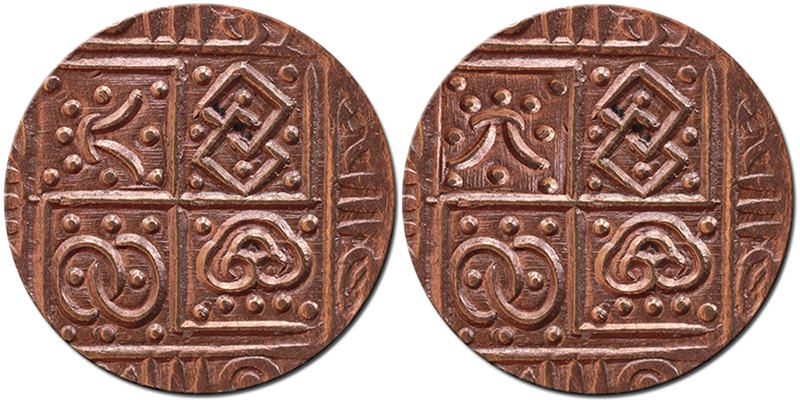
Unfortunately, I also notice that there are mistakes in the positioning of the motifs on the coins. Obviously the Indians at the Calcutta Mint did not know how to correctly position the motifs. As you can see, the motif “Gyeltshen” on the following coin to the left is wrongly positioned. It should have been positioned like the one to the right:


The wholly Bhutanese motifs depicted on the coins encased within a Swastika are as follows:


The interpretation of the motifs are as follows:


The following coin also shows two of the motifs being positioned wrongly:

They should have been positioned as follows:


The errors ofcoure do not end here - as I had mentioned in one of my earlier posts on the subject, the mistakes occurred even in our milled coins of silver and nickel of 1928, 1929 and 1954.

For a while I was undecided whether the above coins belonged to someone else - other than Gongsar Ugyen Wangchuck. But when I looked at the design of one of his other, even more significant coins, I am now in no doubt that the above coins are his.