Tuesday, October 19, 2021

Death By Ladoog I

It would be incorrect to say that the incidences of death by Ladoog is a modern phenomena. I can say it with certainty that it would have happened in the past but remained unreported or, the cause is bound to have been misinterpreted or misunderstood, which is still the case.

Ladoog in Bhutanese literally translates to “mountain poison”, or sickness of the mountains. Most Bhutanese believe or are told that it is caused by the release of strong or pungent smell by the medicinal herbs/trees that grow at high altitudes.

This is a total misconception.

People have also irresponsibly propagated the idea that Ladoog can be cured by chocolates and wheat Sampa diced with sugar.

This is yet another total nonsense. Sugar provides instantaneous but temporary energy – thus misleading people that they have the energy to climb.

Even educated people believe that the Ladoog can be cured by Diamox or that simulation by Gamow Bags will cure altitude related sicknesses. While I agree that Diamox can help accelerate acclimatization at high altitudes, it is NOT A CURE. The Gamow Bag mimics a lower altitude by increasing air pressure around the affected person put inside the Bag. In fact I advise trekkers destined for high altitudes that they should not take the tablet because in my view taking this tablet can result in a false sense of safety. Not many can afford Gamow Bags.

One must know that Ladoog can be fatal. It can kill within hours.

Last week a friend faced a near death Ladoog experience in Laya, unknowingly. My instinct nudged me to call her and find out how she was doing since I hadn’t spoken to her in a year or so, only to find that she was returning from a trip to Laya at an altitude of 3,800 Mtrs. or nearly 12,500 ft. When she recounted her experience to me over phone, I realized that she was clueless about what Ladoog was all about. She had no idea that she was hit by Ladoog. Fortunately, she was lucky that she had an uncommon instinct that told her that something was seriously wrong. She descended to Punakha – and spared her parents the painful experience of having to go through the motions of her last rites.

This article is the result of my conversation with that friend and how utterly ignorant people are about Ladoog and its consequences.

“Ladoog” I believe is a collective term used by the Bhutanese to describe the following three different forms of altitude related sicknesses:

Acute Mountain Sickness (AMS)

High Altitude Pulmonary Edema (HAPE)

High Altitude Cerebral Edema (HACE)

All the above three can result in fatalities. That is as certain as night and day. There is absolutely no cure.

Symptoms of different types of AMS

A person will begin to experience the above conditions once he or she crosses the threshold of 8,000 ft. altitude. The barometric pressure at high altitudes causes the conditions described above. Higher one climbs, thinner the air gets, resulting in lesser supply of oxygen than that which people are generally used to.

The other reason why people get hit by the above conditions is because they gain height too quickly – before the body is able to adjust to the barometric pressure of the location at which they are. That is the reason why I insist that trekking groups coming from low lying areas and landing in Paro should acclimatize for atleast 3 days – either in Paro or in Thimphu - before they are allowed to undertake a trek.

The human body must be allowed to acclimatize with the changing barometric pressure around them. This means gaining height must be done gradually.

There are so many misconceptions surrounding altitude related sicknesses – I believe that the BBS should do a program in all the national languages – to educate the people on AMS related matters – how to prevent them, how to prepare for and how to avoid them. This has become important in recent times since I notice that people have taken to trekking to high altitude pilgrimage sites. BBS would be doing a service to the nation and in the process avoid preventable deaths. This has become an URGENCY.

I suggest that the tour operators who are conducting these pilgrimage tours should be required to be TCB certified operators with proper grounding in the knowledge related to AMS. The pilgrims should be made aware of the AMS related matters – so that they can make informed choices.

I have already seen 3 altitude related deaths – one in Jele Dzong in Paro, one in Singye Dzong in Lhuentse and one in Nagchung-La Pass in Merak. The girl who died in Singye Dzong was on a pilgrimage along with 16 other women. Despite my repeated requests to the group to descend to a lower altitude, the young girl succumbed to the condition – she was only 28 years old.

It was sad and such a waste of precious life.

Thursday, October 14, 2021

Deciding the Obverse and the Reverse of the Ser Nya Maartam

Our Maartams were hammered a few centuries back – thus it is impossible to say with any degree of certainty which side of the coin was intended to be the obverse and which side the reverse.

I was for a moment perplexed as to how to decide on the following coin’s sides. Outside historians call this coin “2 Fish Coin”. But I am changing that. I am going to call this variety of coins – the “Ser Nya Maartams” because one side of the coin depicts one of our Tashi Taag Gye (8 Lucky Signs) – the Ser Nya. The other side depicts the Bengali/Assamese term “Dhra”.


Ser Nya Maartam with a Cross on the Obverse

In truth, there appears to be an accepted convention in the minting world – that the obverse side should hold the more important information or that the start of the information should begin at the obverse of the coin and end with the reverse of the coin. This would imply that we should designate the side with the important information as the obverse and the other as the reverse.

Thus, since the Ser Nya is more important to the Bhutanese than the Bengali/Assamese “Dhra”, we should, therefore, designate the side with the Ser Nya as the obverse of the coin.

Tuesday, October 12, 2021

Thank God That Things Happen For a Good Reason

After many years of research and examination of evidences, I finally decided that I had done enough. I could now begin to put together my book on the coining journey of Bhutan. The delays have been monumental, given the conflicting reports on Bhutan’s coinage.

I believed that I had them all sorted out, only to realize that there was yet another problem that had almost escaped my attention.

Historians put the date of Bhutan’s coinage from 1790 to 1910. Thus I had finalized my dates accordingly. Then to my consternation I discovered that the starting date of our coinage should be 1711. If that were not enough, this morning as I was putting the dates to some of the hammered coin varieties, I realized that the dates are yet again wrong. Wrong because as of the beginning of monarchy in 1907, the posts of Punakha Dzongpoen, Wangdue Dzongpoen and Daga Poenlop ceased to exist. Only the posts of Choetse Poenlop and Paro Poenlop exist to this day. Thus the abolished regional rulers ceased to have authority to hammer coins.

Consequently, my following dates pertaining to the three Dzongpoens’ coins would be wrong. It is now being corrected as follows:


Corrected dates

Trongsa Poenlop’s coining date for the hammered variety should actually be upto 1910. However, I am keeping it at late 1800 since around that time Trongsa Poenlop Jigme Namgyel began to hammer a different variety of coins called Norzang Phubchen – in silver and copper. Beginning with this coin, every coin – in except one coin variety - the Cooch Behari alphabets were entirely done away with. These coin varieties hammered until 1929 is distinct from earlier hammered coins.

Thursday, October 7, 2021

How Some Of Us Think

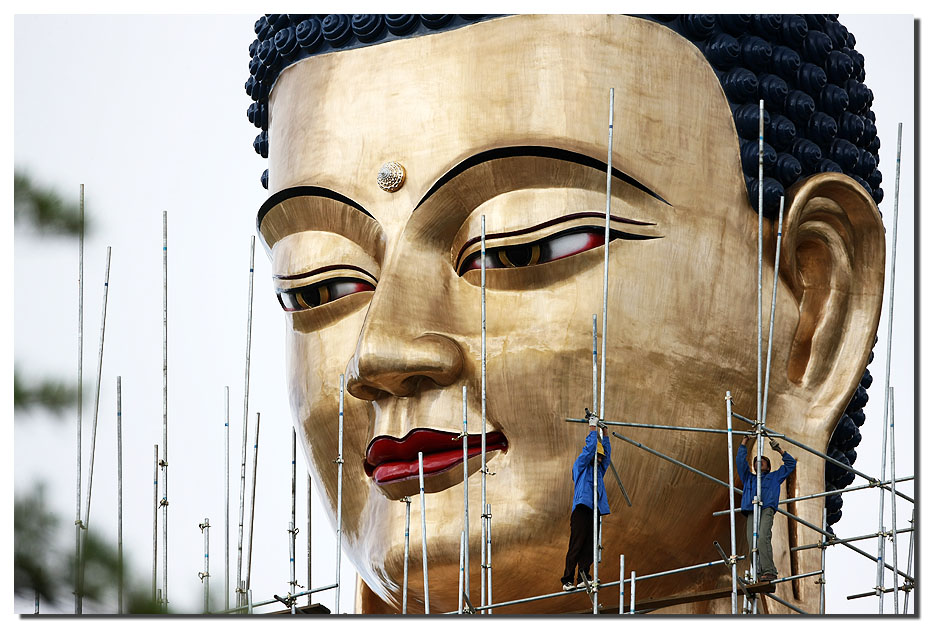
In 2011, I photographed the face of the Buddha Dordenma at Kuenselphodrang, as the scaffolding to mount the Third Eye was being dismantled by the Chinese workers. That was when I noticed the scar on the left face and ear of the Buddha.


Scars on the face and ear of Buddha Dordenma

I brought the matter to the attention of the then Prime Minister JYT with an appeal to order the correction of the flaw. The Buddha Dordenma project is a monumental project and such shoddy work cannot be accepted. The serene face of the Buddha should not have scars on it.

The Lyoenchen called the Lama or some person who was in charge to explain the shoddy work.

I am told that the Lama or the person in charge responded to the Lyonchen saying that the flaw became visible because I had a very good set of camera gear.

To the person, it did not matter that there was a flaw – what mattered was that the flaw was detected only because I had a good set of camera gear.

Strange way of thinking.

Sunday, September 26, 2021

A Great Loss: Sad Demise of Dr. Diana Natalicio of UTEP

I was greatly distressed when Rotarian Dawa Penjor from Gelephu called me up to inform me of the sad demise of a great educator and one of Bhutan’s most valuable friends in the US. I had met the distinguished lady twice. And I continued to be in her company – as a co-Council Member of the Bhutan Foundation’s Advisory Council.

It was due to this great lady that many of us Bhutanese parents could afford to send our children to one of US’s top ten universities - University of Texas at El Paso (UTEP). My youngest son spent five years in this great institution of learning. Without her love and special consideration for Bhutan and the Bhutanese, I could not have afforded to educate my son in UTEP.

I was truly grateful for this lady for her special love for Bhutan. In fact I wrote to the erstwhile PDP government – on three separate occasions (last request was sent to the government on June 28, 2018) – requesting the government to invite the lady to Bhutan as a government guest – to show how grateful Bhutan is about her competent stewardship of the institution where preferential treatment is accorded to our children – in preference to all others. The PDP government wasn’t interested.

In desperation, I spoke to the Members of the Rotary Club of Thimphu – requesting them to allow me to invite her as our Club’s guest since the government was not interested. The Members agreed. Sadly by the time I was ready to send out the invitation, a decision had already been made by UTEP to fund the travel to Bhutan of the President Dr. Natalicio accompanied by Dr. Catie McCorry Andalis, Associate Vice President and Dean of Students. All travel arrangements had already been made and air tickets already purchased – at their own cost. A great opportunity to show gratitude was lost to Bhutan.

And now she is no more.

Dr. Natalicio’s last visit to Bhutan was in October of 2019.

I blogged about UTEP and Bhutan connection. Please read about it at the following:

https://yesheydorji.blogspot.com/2021/01/mini-bhutan-in-us.html


Dr. Diana Natalicio

UTEP President Dr. Diana Natalicio, far left, with the erstwhile Secretary of the Royal Civil Service Commission, Dasho Bap Kesang, far right, and Director General of the Cabinet Secretariat, Mr. Sonam Wangchuk (center), in Bhutan in March 20, 2007. An MoU was signed offering scholarships to Bhutanese students.

May her soul rest in peace.

Wednesday, September 22, 2021

Two New Discoveries

Two new discoveries have puzzled me greatly. One is that there is also a “Sa” imprinted on the Tibetan silver Sichuan.


Sa counter-marked on Silver Sichuan Rupee of the flat nose minted for Tibet

Our ancient Maartum with "Sa" is the most abundant coins currently available in private collections and in handicraft shops. And it was coined earlier than the silver Sichuan which was minted sometime during early 1900's. So it has to be that the Tibetans (rather Chinese since the coin was minted in Sichuan) borrowed it from Bhutan. But what is the connection?


Bhutanese "Sa" Maartum

The other discovery is the term “Nyingtam Ghatikap”. The terms translate to: Old Coin from Ghatika. This means that our silver coins were hammered in a mint located in a place called Ghatika. As you know if a person from Chapcha is named Tshering, he would be called Chapchap Tshering; Dagap Thinley; Sharchop Pema etc. Likewise a coin hammered in Ghatika would be Nyingtam Ghatikap.

There is a place called Ghatika in West Bengal, India. But I am now trying to find out if there was a mint there during the ancient times.


Location map of Ghatika

According to History of Bhutan by Bikram J. Hasrat, the term he uses is Ngultrum Ghatikha. But a knowledgeable person in Bhutan says that the term should be: Nyingtam Ghatikap. The term Ngueltrum came much later. The person says that his late father would pronounce the terms as Nyingtam Ghatikap.

Friday, September 17, 2021

Earliest Bhutanese Coins: Obverse & Reverse

Bhutan’s coins were hammered some 310 years back – thus it cannot be said with certainty which side of our coins was intended to be the “obverse” and which the “reverse”. Thus I believe that we will have to rely upon our own power of reasoning as to which should be which.

In an article by John Deyell titled “Reflections on “Obverse” and “Reverse” in numismatics, he writes:

“The implication is that each has a “front” side that is by the standards or conventions of the industry somehow more significant, higher-quality or otherwise of greater importance, than the other side, the “reverse” side. Where the medium bears information, as is the case with coins, banknotes, printed pages or discs (double-sided DVDs, etc.), the obverse or front is the side on which the message begins and the reverse carries the remainder of the information.”

…. and ends with:

“The only solution is for scholars to define obverse and reverse in terms of the priorities they consider most important and then be consistent in their own work”. Probably a good last word on the subject!”

I had difficulty in deciding which should be considered the obverse and which the reverse of our coins – or more simply which should be the front side and which the back side. I spent many months brooding over the matter. I consulted a number of experts, writers and historians across the globe. But at the end of it all, it was really very simple - there was nothing so complicated about it.

We should simply follow the Koch Kingdom's scheme.

As confirmed to me by Mr. S. K. Bose, Past President of the Numismatic Society of India, in the scheme of things thought up by the Cooch Beharis from whom we borrowed the idea of our earliest coinage, the side with the "Cha" is the obverse or the front of the coin and the side with the “Ndra” is the reverse or back of the coin. The reason why the "Cha" side should be the obverse is because it carries the name of the Hindu God “Shiva”. Thus, in the scheme of things of the Cooch Beharis, the side with the name of the God Lord Shiva takes precedence over the side with “Ndra” which is part of the name of the ruler of the Koch Kingdom who issued the coins.


Half Silver Rupee of Maharaja Devendra Narayan of Cooch Behar

Thus for us too this rule should apply – because Lord Shiva is also considered God in our religion. He is known in our religion as “Lha Wangchuk Chenpo” – sometimes also called “Wangchen Deva” or simply “Maha Deva”, among others.


Bhutan's silver "Sa" Ngueltum - one of the very few coins with full die-sized planchet

The side with the "Ndra" cannot be considered obverse for the Bhutanese since it carries the name of a Koch king. This will be in keeping with the order of importance - God first!

Tuesday, September 14, 2021

What the Dang Hell Is Gya Chila??

 Hi .................,


I cracked the mystery of  “Gya Chila”!!


I went to speak to someone called Lam Kesang Chhoephel. He is the CEO of APIC (Agency for Preservation of Indigenous Crafts). He is a qualified and learned Lama. So I asked him if he had ever heard of “Gya Chila” …. He said never. But as we dwelled over the matter and began to wonder what would be “Gya Chila”, he came up with:


“This cannot be “Gya Chila”. It has to be “Ja Chila”. Sometimes foreigners tend to grasp our words wrongly. As you know, Ja is short for “Jaggar” which as you understand means India or Indian. So it must mean Poenlop of India – "Ja Chila".


I totally agree with him!


As I said in my earlier mail, if a regional ruler is a Lam, he would be called “Chila” and not “Poenlop”. That is why the title of the first Mangde regional ruler Chogyel Minjur Tempa was called “Choetse (Trongsa) Chila” because he was a Lam. Whereas Jigme Namgyel was called Trongsa Poenlop or Choetse Poenlop.


The Ja Chila under reference must have been a Lam or Lama. He would have been appointed by the 8th Druk Desi Druk Rubgye who ruled between 1707 – 1719.


“This strengthened the position of the Bhutanese who stationed in Cooch Behar their agent named Gya Chila along with an escort. Bhutan went a step further and struck the Ngutam (a silver coin) for circulation in Cooch Behar thus undermining the independence of Cooch Behar as a State.”


I will reply to your other mail tomorrow.

Friday, September 10, 2021

Re-Christening Bhutan's Earliest Silver Coin

 Dear Mr. Bose,

Good Morning … I hope you are continuing to keep well and safe.

Regarding my yesterday's mail to which was attached a .pdf file about my views on the coinage of Bhutan’s earliest Maartams, I believe that I may have made a mistake regarding my views on Bhutan’s silver “Ma” Maartams. I feel that others may be right – that the silver “Ma” Maartam may indeed be Bhutanese. I came to this conclusion after realizing that I failed to look at the Maartam’s obverse where the Bhutanese numeral “1” is inscribed.

I took a careful re-look at the Maartam’s image and I find that if I consider the coins obverse, I can see a perfect Bhutanese number “1” inscribed inside the CHA. The number there is a perfect Bhutanese “1” - as written by the Bhutanese. It is no where close to how the Bengalis/Assamese would write. The Assamese/Bengali 1 is written completely differently - from how the Bhutanese write ours.


Bhutan's earliest silver coin


A comparative study of the Assamese/Bengali/Bhutanese number 1 and alphabet "Ma"

Finally, in my upcoming book I am going to rename the “Ma” Maartam as “Ma” Ngueltum. The reason is that "Ma" Maartam actually means red coin whereas “Ma” Ngueltum would translate to: “Ma” Silver Coin.

There is a term “Nyingtam” which means old coin. As the oldest coin, the “Ma” Ngueltam could also be called “Ma” Nyingtam but I think “Ma” Ngueltam would be more appropriate.

Bye and take care


Wednesday, September 8, 2021

Say No To Plastics

In a landmark decision during the Club’s Weekly Meeting on Friday the 3rd of September, 2021, the Rotary Club of Thimphu resolved as follows:

AGENDA 3:

Rtn. Yeshey Dorji proposed to the Members that our Club should henceforth decline all and any projects that have components of supply of non-biodegradable Shed Nets, Green Houses and Mulching Plastics. He said that supporting projects that require these environmentally harmful plastics is in conflict with Bhutan’s environmental friendly image. He said that the Club could, however, accept the donation of plastics that are bio-degradable and harmless to the environment.

The Club President and other Members present in the Meeting agreed with the proposal and said that we should do nothing that would contribute to environmental degradation. Additionally the Members were reminded that as of this Rotary Year 2021-2022, Rotary International had adopted a new and its 7th area of focus – ENVIRONTMENT. Thus in keeping with the Rotary International’s endeavors to support the protection of the environment, all the Members agreed that Rotary Club of Thimphu will forthwith not support any agriculture projects that have components of supply of non-biodegradable shed nets, green houses and mulching plastics.

Over the last six years, the Rotary Club of Thimphu’s contribution to the country’s agriculture sector has totaled over Nu.13.00 million. Of that quite a substantial amount went into supporting the supply of shed nets, green houses and mulching plastics.


One of the many large greenhouses donated by the Club in support of agriculture production

The government talks of organic farming but they officially supply fertilizers and weedicides and pesticides. They make a show of banning plastics but subsidize the installation of shed nets, green houses and mulching plastics. They are mindless about where these plastics will ultimately end up.

Today because of the irresponsibility and poor stewardship of the agriculture sector by the people at the helm of things, the country is strewn with thousands of miles of plastics that will ultimately end up inside the belly of the mother earth. If we cannot contribute to the improvement of the health of the environment, let us not contribute to its deterioration.

Let us be more responsible than our government has been – Let us stop the use of non-biodegradable plastics in agriculture production.

Monday, September 6, 2021

The Rotary Club of Thimphu Is Yet Again At It!

As always we are frantically busy delivering humanitarian service during these painful times. This time it is a small school in Samtse – a school by the name of Sang Ngag Choeling Lower Secondary School - with students numbering a little over 300. To safeguard the children from the COVID-19 virus, the school authorities requested the Club for Hand Washing Stations and some Face Masks. And we were happy to oblige. The school Principal picked up the PPEs a few days back from our office in Thimphu.


The Club President, Club Secretary and Community Service Director of the Club hand-over two units of Hands Free Hand Washing Station and 1,005 Nos. of reusable fabric Face Masks to the Principal of Sang Ngag Choeling Lower Secondary School

Not to be outdone, the Lakhu Primary School in Punakha wanted us to help with electrification of their bathrooms and toilets. Few hours back, our Executive Secretary conveyed to the school Principal – to go ahead and start the wiring and purchase of whatever is needed – to electrify their toilets and bathrooms. Our Club Members approved the needed budget during our last Weekly Meeting on Friday.

By this afternoon, our Club will be delivering 4 more hands-free Hand Washing Stations to Gelephu based “Friends of the Frontliners” – a group responsible for initiating the construction of a soon to open 200-bedded Quarantine Center in Gelephu. Two of the stations are due to be installed at this Center and the other two will be installed at the entry gate at the border adjoining the Indian border. The request was generated by our Gelephu based Club Member Rtn. Dawa Penjor who is a Member of the  group “Friends of the Frontliners”.


4 Nos. of hands-free Hand Washing Station for the Friends of the Frontliners” of Gelephu

Few months back the Club had donated 83 of these hands-free systems to Thimphu Thromde - for installation at places of mass gathering and heavy human traffic.

In the coming days we will be handing over a 12,000 ltrs. capacity SkyHydrant water filter to the newly opened school in Phadhuna in Punakha, established to accommodate the relocated students from Phuentsholing numbering some 887 students. The filter is already installed and was ready before the children arrived.

It is getting a little hectic – but hey!, this is SERVICE TO THE TSA WA SOOM – at its humblest!


Sunday, September 5, 2021

Rewriting History of Bhutan’s Modern Coinage

The Annual Report of The Director of Mint, United States Government Printing Office, Washington – for the fiscal year ended June 30, 1930, reads as follows:

US government mint report for the year 1929

The coinage about which the above report speaks of is Bhutan's first ever milled silver Thala of 1929. A total  of 20,000 pieces were struck - valued at Nu.10,000.00. The following is the coin the obverse die of which was erroneously crafted.


The Thala of 1929 with the erroneous obverse

The Annual Report of The Director of Mint, United States Government Printing Office, Washington – for the fiscal year ended June 30, 1931, reads as follows:

US government mint report for the year 1930

The coinage about which the above report speaks of is Bhutan's second milled silver Thala of 1930. In an effort to correct the mistake in the obverse of the Thala of 1929, a second lot of 30,000 pieces were struck - valued at Nu.15,000.00. Unfortunately while the obverse was corrected, the reverse was yet again flawed. The mint used the same old reverse die. Thus while the year of coining should have been stated as "Sa Drue Lo", it was erroneously indicated as "Sa Druk Lo".

The following is the silver Thala of 1930:

The second issue of the silver Thala - with the wrong year of coinage

As of now the dates of issue for the above two Thalas are recorded as 1928 and 1929. I will be correcting the record in my upcoming book on Bhutan's coining journey.

Tuesday, August 24, 2021

Bhutan's Ancient Monies

Dear Mr. Bose,

As informed in my yesterday’s mail, contrary to what Mr. N Rhodes wrote, Bhutan did use Cowrie or seashells or Karshapani - as it is known in the local language – as money. There is written proof of it in an ancient ritual prayer book called “NAMSAY YANGKHUG”. It is a book dating back to the time of Buddha – it praises NAMSAY the God of Wealth and in it the people entreat him for a hundred thousand Karshapani on a daily basis. You would know the God by its Hindi name – Kuber or Kubera.

Obviously this book proves that the Cowrie pre-dates the use of salt as currency. Bhutan also used salt as currency – as did few other countries around the world such as – the UK.

My book will carry two articles that describe the use of Salt and Karshapani as monies. For now as desired by you, I reproduce below a small portion of page 423 of the book where the narration: “Please gift us, on a daily basis, a hundred thousand Karshapani” appears.


The text on page 423 zoomed in


Translated into English

Monday, August 23, 2021

One For The Hilltop

The Rotary Club of Thimphu continues to deliver humanitarian service – unabated. The latest in the series of projects we implemented was the delivery and installation of a 12,000 liters capacity, gravity activated, patented, SkyHydrant water filter at the Tango Center for Buddhist Studies. The filter is large enough to cater to the needs of both the Tango Dzong as well as the institute.


SPBD's Engineer Sonam Norbu handed over the filters on behalf of the Club

This 3-years, one million Australian Dollars project is a collaborative effort between the Ministry of Education and the Rotary Club of Thimphu. The funding is provided by Disaster Aid Australia – a Rotary created NGO based in Melbourne.


Saturday, August 21, 2021

Koch Kingdom's Earliest Silver Coin Found in Bhutan

Relations between Bhutan and the Koch Kingdom (modern day Cooch Behar within the state of West Bengal) go back centuries. In fact written records now confirm that Bhutan’s earliest silver Maartums were hammered in Cooch Behar – not in Bhutan. Those coins were most often referred to as Deb Rupee – Rupee of the Deb – or Druk Desi’s coins. The metal used was silver.

Bhutan was flush with foreign coins – I believe that of the coins of eight foreign countries that found their way into Bhutan, the most numerous were the Narayani of Koch Kingdom, Baltum from Nepal, Boetum from Tibet and Rupee of East India Company/British India Government. The earliest of these coins were all in silver.

Amazingly, some of those coins still survive in Bhutan. Recently I acquired the following Koch Kingdom’s earliest known silver coin – called the "Narayani" - symbolically from a remote village in Chhukha, close to the State of West Bengal:

10.00 gms; 24.02 mm

Silver Narayani of Maharaja Naranarayan - issued during his coronation in 1555. Supposedly this is the first ever coin issued by the Koch Kingdom.

Koch Kingdom’s most powerful king - Maharaja Naranarayan, son of Maharaja Biswa Singh of Cooch Dynasty, issued the above coin. It was issued to commemorate his coronation that took place in 1555. Thus this coin is close to four and a half centuries old.

During late 1780's, the British government shut down the Cooch Behar mints - resulting in stoppage of supply of coins to Bhutan. This is when Bhutan was forced to start to hammer our own coins. Some say hammering coins in Bhutan began in 1790.

In 1866, the British India government stopped the circulation of the Narayani coins altogether. Thereafter no Narayanis were issued, although the ruling Maharajas of Cooch Behar did issue commemorative coins on the first day of their accession to the throne.

UPDATE FROM AN EXPERT:

A coin historian and an expert on Indian coins tells me that I have the earliest version of the coin. He explained that in the earliest version, the alphabets were separated. The later versions had joined alphabets - as follows:


Sunday, August 8, 2021

My Dream Project ….. Sloooooowly Beginning To Take Shape

Realizing my dream project – a coffee table book on Bhutan’s coining journey – has taken more time than it should. There are a couple of reasons for it – firstly I have to put in many grueling hours every day for Rotary work, leaving me with little time for the project. Secondly, I find that much of the recorded history turns out to be faulty. Thirdly, getting to photograph the coins in the right way has been an exercise in futility. But after trying for over a year, I believe that I have finally nailed it. The following images should tell you that it cannot get any better.

As a rule, collectors do not clean old coins. But a soiled coin makes for poor detail – thus my book will feature coins that have been cleaned – for clarity of details. Centuries of handling by thousands of people result in the deposit of layers upon layer of grime on the coin’s surface. A coin caked with grime may look ancient and collectible – but much of the coins details remain concealed. The only way to bring out the details of the coin is to give it a cleaning treatment.

Tibet is perhaps the first country with whom Bhutanese interacted, including Nepal with whom we were in touch – as far back as early 1600’s. We even had a postal service running between Kathmandu and Punakha. Thus in addition to Boetum (coin of Tibet), we also had Baltum (coin of Nepal) entering our country. In total coins of eight foreign countries were available in Bhutan:

Tibet

Nepal

Koch Bihar

Assam

British East India Company

Crown British India or British Raj

French East India Company

China

The following are some of the coins hammered by Bhutan – supposedly beginning 1790 - 1910. After 1910 when Gongsa Ugyen Wangchuck ruled as King, new breed of coins began to emerge. They were produced from machine cut dies. As of 1928, machine milled coins came into being - during the time of the second King, His Majesty Jigme Wangchuck.


Bhutanese Maartums

The following are some of the coins of Tibet. Tibetan coins were the most numerous. Thus my book will feature 9 coins of Tibet while only 3 each of other foreign country’s coins will appear in the book.


Tibetan Coins

By the way, the colored background on which the coins sit is actually a row of colored prayer flags that flutter on the hillock where the Dechenphodrang Lhakhang stands - I wanted just their colors, which I achieved by throwing off the details of the prayer flags – through the selection of very low aperture on the camera’s lens.

Let us see if the prayer flags will bring me much fame and fortune - I need both 😋

Wednesday, July 28, 2021

The Emergence of the Idea of Paper Money for Bhutan

Every nanosecond, history is being made and remade and unmade, in some corners of the earth. The intention behind their making is not always premeditated – a good portion of them are accidental - pure chance and, at times, out of frustration. Ostensibly, one such history was played out in Paro – to be precise at Ugyen Wangchuck Academy in Satsam Chorten – possibly the earliest emergence of the idea of paper money for Bhutan, in place of the weighty and cumbersome cupro-nickel Tikchungs.

A verbal narration given to me by a friend goes like this:

Mr. Michael Rutland, currently the British Honorary Consul to Bhutan, joined Ugyen Wangchuck Academy in 1971 – as a Royal Tutor. He had to be paid monthly salary, which he believes was delivered to him on horse back - from Ugyen Pelri Palace in Paro. Her Majesty Queen Ashi Kesang Choeden Wangchuck wanted to make sure that Mr. Rutland got paid, and in time. Her Majesty instructed the late Finance Minister Lyonpo Chogyal to personally oversee the delivery of the salary – in the form of Tikchungs packed in cotton bags.

In keeping with Her Majesty’s orders, Lyonpo Chogyal ensured that the salary was delivered to Mr. Rutland in time and in the right amount. Not to say that they were any use to him – there was nothing that he could buy with them – even for a piece of cake he had to drive all the way to Swiss Bakery in Thimphu.

One evening Mr. Rutland met Lyonpo Chogyal at a dinner and he had the opportunity to thank him personally for delivering his salary in time. Lyonpo Choyal wished that there was a simpler way to deliver the salary - he wished that he could issue a written document signed and sealed by him to Mr. Rutland, and he could use it to purchase whatever he wanted. The conversation resulted in Mr. Rutland pulling out a British Pound bank note and showing it to Lyonpo and telling him that back home in England – they used paper money to pay for services and everything else. They were light and available in various denominations.

Although not educated in western education and their monetary system – the profundity of such a concept did not escape the old man Chogyal. The idea stuck with him and he began to ponder over the possibility of introducing Bhutanese paper money. Eventually, while it is not clear if he was responsible for the happenstance – Bhutan’s paper money got printed and issued, for the first time, in 1974.


Bhutan's earliest bank notes released in 1974

Lyonpo Chogyal is no longer alive but Mr. Michael Rutland is still around. I had the occasion to ascertain the veracity of the oral account as narrated above. He confirms that the account is accurate - to the last word.


Sunday, July 25, 2021

I Think I Finally Nailed It!

For the past over one year, I have been trying and trying and trying, to improve my coin photography. I wasn't getting it - however hard I tried. Unbalanced lighting, ghosting, uneven sharpness, reflection and shadows caused me misery. I was not at all satisfied by what I produced. But I am not one to give up - I aim for perfection.

Then a few days back - I nailed it! Take a look at the following three sets of coins and you know what I mean.


The coin set at the top and middle are Bhutanese Maartams - hammered between 1790 and 1910. The coin set at the bottom is Tibetan Sho Gung - minted during the 1st Year of 16th Rabjung (Fire Rabbit Year: 1927).

As you can see, there are no shadows, the sharpness is spot on and the color is vibrant! Goes to show - if you keep trying, you will eventually get it. Never give up!

ENJOY!

Thursday, July 22, 2021

The Aliens Did Not Do It

Garbage is ugly – it is dirty and it stinks. Regardless it is not the aliens from outer space that generate them – it is us who do. Thus, it should be us who should take on the responsibility to dispose off the garbage safely, securely and in a way that it does not harm the natural world around us. But we won’t – because we reason that there are some agencies and organizations that are charged with the responsibility of managing the garbage – and they are paid for the job and they draw sustenance in the name of managing garbage. The truth though is that garbage should be everybody’s responsibility. If the people who are charged with the responsibility fail to do their job, we should not fail in fulfilling our duty - as responsible citizens.

The case of the two piles of garbage by the wayside in Dechenchholing area is a case in point. For close to two months, I noticed that there were two huge piles of garbage dumped by the roadside – on two separate locations – on the road leading to Dechenphu Lhakhang. For a while I believed that they would be disposed off by the people and agencies responsible – but at the end of nearly two months, they remained where they were – unmoved, unattended and threatening to be gnawed open by the rummaging stray dogs.

Monks, religious aficionados on their way to Dechenphu Lhakhang, archers and fitness freaks and even romancing couples pass that road on a daily basis ... and yet the two piles of garbage remained unattended to. Finally I realized that no one was going to be bothered about the unsightly piles – neither the garbage collectors nor the pseudo environmentalists. I decided that I would have to do the job myself. Over two evenings, with the help of a DeSuup, I broke up the three huge piles of garbage into manageable sizes and carried them in my car, to be deposited at the garbage drop off points.


The piles of garbage on the way to Dechenphu Lhakhang as photographed on July 7, 2021


On July 11, 2021 I managed to carry away 2 of the 3 piles of garbage. I could not manage all three because they needed to be broken up into manageable bundles so that they fit into my car


By the evening of July 12, 2021, all the three unsightly garbage piles were removed and the area looked green and clean


Let us not be hoity-toity about handling garbage – we created them – we have to be responsible for their safe and proper disposal.


Sunday, July 11, 2021

Lonely But Busy As Hell

Rotary Club of Thimphu is the lone Rotary Club in Bhutan. It was chartered in 2012 under the aegis of the DPT government. Since then, the Club has never looked back.

We may be lonely, but certainly we are among the world’s busiest Rotary Clubs - even in the middle of the COVID-19 pandemic. To date, including seven projects that are currently in the pipeline, the Rotary Club of Thimphu has completed 91 community service projects, valued at over Nu.140.00 million.

While a large section of the Bhutanese population has been rendered jobless and hapless, the Club officials at the Rotary Club of Thimphu have been running helter-skelter – handing over projects and delivering project equipment. In the middle of the raging pandemic, we are proud to have have been able to deliver the following:

21st October, 2020

The following photo is from the Club’s archives – it shows the Club's Past President Rtn. Dr. Lam Dorji and Foundation Chair Rtn. Tshering Choki handing over the donation of a 30 Kgs. per charge capacity medical waste incinerator to the officials of the Ministry of Health. This is the first of three units being donated by the Club to the Ministry of Health. This unit was destined to be installed at Memelakha, for use by the JDWNRH, Thimphu.

First of the three units of medical waste incinerators being handed over to the Health Ministry officials

July 6, 2021:

Handed over a 100 Kgs. per charge capacity medical incinerator to Paro Dzongkhag Health officials, including Dzongkhag authorities. This is the second of the three medical waste incinerators that our Club is donating to the Health sector – to combat COVID-19 pandemic. This one is due to be installed at Paro.


Second of the three units - this one a 100 Kgs per charge capacity medical waste incinerator - being handed over to the Health and Dzongkhag officials of Paro Dzongkhag.

July 7, 2021:

Handed over another 30Kgs capacity medical waste incinerator to the Ministry of Health – represented by Ms. Pem Zam, Infection Control Program Officer, MoH. This is the last of the total three medical waste incinerators that our Club is donating to the Health sector – to combat COVID-19 pandemic. This unit is destined for Nanglam Government Hospital. With the handing over of this unit, the Rotary Club of Thimphu completes its Medical Waste Incinerator Project with the Ministry of Health – valued at a total of Nu.6.5 millions.


Last of the three units of medical waste incinerator being handed over to the Health Ministry official - this one is destined to be installed in Nanglam, Eastern Bhutan.

July 8, 2021:

One of the Club’s principal areas of focus is agriculture production. In line with this area of focus, we handed over the completed construction of a mushroom incubation and harvesting shed - measuring 60’ in length and costing Nu.583,000.00. The project was handed over to the group leader of a women farmer group in Phangyul village, Wangduephodrang. The funding for this came from a private donor and Rotary Club of Brooklyn Bridge, USA.


A 60' long mushroom incubating and growing shed being handed over to the farmer group leader accompanied by local government officials and Agriculture sector representative.

July 8, 2021:

The same day before the above handing over ceremony, the Club officials visited a very remote school in Punakha called Lakhu Primary School. The school wanted one additional water filter – we had already donated one earlier. After the visit it was ascertained that they really do not need the additional filter since the student enrolment is less than a hundred. The matter will be discussed further among Club Members to see if it would be more meaningful to support them with installation of electricity in their bathrooms that are currently without electricity.


Water filter that was supplied sometime back by the Rotary Club of Thimphu - working very well at Lakhu Primary School, Punakha

July 9, 2021:

The last in the series of project implementations for this month, we handed over a 12,000 lts. per day capacity SkyHydrant water filter to Dechenchholing Higher Secondary School in Thimphu. Dechenchholing HSS has the country’s largest number of students – totaling close to 2,000 including teaching and support staff. This is part of our Club’s ongoing project valued at AUS$1.00 million – to supply safe drinking water to Bhutan’s largest educational institutions - in collaboration with Disaster Aid Australia. Installation of all the promised 120 filters will be completed this September – the last of the 23 units are in stock with us - awaiting installation. The progress of installations have been rather slow due to limitations placed by the pandemic.

The Past Presidnet Dr. Lam Dorji handing over the SkyHydrant water filter to the Vice Principal of Dechenchholing HSS

There is no respite - in the coming weeks, I start work on a funding proposal for a agriculture project in Chhukha Dzongkhag, followed by a number of COVID-19 related projects to help the government contain the COVID-19 pandemic.