Friday, May 28, 2021
Bhutan’s Early History: Separating Fact From Myth - VI
Wednesday, May 26, 2021
A Most Rare Find!
When one is passionate and dogged in the pursuit of one’s aspirations, it appears that things will eventually fall into place. In trying to put together a book on the coining journey of Bhutan, I have been through thousands of hours of search and research. Thankfully, not all of them have been in vain – in fact some of them have been providential – as if it were preordained. I have stumbled on the most unexpected encounters and discoveries - as if some unseen hand was guiding them my way.
There are many hundreds - perhaps even thousands of coins that are still missing from my collection. But it is not my endeavor to get them all – it is impossible. I just want to be able to include as many verities as possible.
Coins are one thing – but dies are another. They are even more rare and extremely difficult to come by, if at all. Through the writings of a coin historian, I managed to track down and photograph half a die – a reverse die or the hammer die – belonging to Desi Kitshelpa Dorji Namgyel. What I needed was a complete set of dies – both the obverse, as well as the reverse dies - to go into the book so that readers can get to see how coin dies look.
Few months’ back, I came by the information of the existence of a set of coin dies with someone not far from Thimphu. Even more fortuitous, the brother of the person in whose possession the dies were supposed to be happened to be a long time friend of mine. After doggedly chasing the friend for months to introduce me to his brother, he finally relented and, subsequently, yesterday I managed to photograph the set of dies that are presented in the following. I am clueless as to whom the dies belong to - the current owner of the dies do not either. The only thing I can tell you without hesitation is that the die is a fine work of art – the engraving is so exquisite that it is unbelievable that the dies were hand cut during late 1700’s or early 1800’s. It is in mint condition, as you can see below:
Monday, May 24, 2021
Bodeful Times
Once again the annual Cordyceps collection season is here. Although so far no COVID-19 cases have been reported from the villages that engage in the annual harvests, we still need to be vigilant.
I do not know if it is a cause for worry – but I am a little unnerved by a sudden and overwhelming interest in, of all things, silver coins! In recent times, the whole country is abuzz with talk of Betangs – or more accurately – Boetrums. These are Tibetan silver coins that are most often confused for ours – even by the National Museum in Paro. I prefer to call them by the name “Boetrum” which is a combination of two words:
Boe = Tibet
Trum = Coin
These coins are also known by other names, depending upon their period of coinage, such as: Tangka, Kong-par Tangka, Gaden Tangka, Srang etc. They look like these:
Something is fueling demand for these coins. Amazingly it appears that the entire country is being combed for these coins. Even a villager in one of the remote villages in Tangmachhu, Lhuentse tells me that the entire village is aware of the hunt for these coins. In Thimphu, Paro, Punakha and Wangdue, everybody seems to be talking about the demand for these coins. Someone from Taang in Bumthang asked me about the matter.
Some have opined that there is a newfound demand for them in China or Tibet China – I am not sure which. Regardless of whether the persons seeking to buy these coins are Bhutanese or non-Bhutanese, I would still be worried – because I wouldn’t be surprised if our northern borders end up being used as the exit points for these coins.
Saturday, May 22, 2021
Bhutan’s Early History: Separating Fact From Myth – V
Coining Journey Of Bhutan: Setting the Record Right
Few days back I met up with Ms. Pema Choden Wangchuk – Curator at the Royal Textile Academy. I had gone to deliver some images that she had lost when the Academy’s server crashed. The images were from my assignment with them that resulted in the editing and production of their catalogue titled 'THAGZO: Textile Weaves of Bhutan'. In the course of our conversations, I gave her following advise, since she loves research work:
“Don’t trust even the primary sources because they too cannot be trusted to give you the truth all the time. In the course of my research, I have come across primary sources who would rather further their own agenda, than give out the truth. It is important that we cross-check every fact, revalidate every narrative”.
But it turns out that I had failed to practice what I preached. Just a few days back I found out that I have myself been a casualty of faulty history that I had failed to recheck and revalidate.
For years I have been bewildered with something that remained inexplicable – related to our earliest milled coins. Bhutan’s record keeping culture is so poor that there is not much information that can be had within the country. Thus we end up having to glean through outside records, to learn of events that happened inside the country. Not to say that outside sources are without faults.
Going by the information circulating among the community of world numismatists, it is recorded that for the first time ever, Bhutan issued our earliest milled coins in 1928 – all three of them - in the year of the Earth-Dragon (Sa Druk Lo):
One Silver Thala
Two sizes of Bronze coins called Zangtrums
It was noticed that there was a problem with the obverse of the silver Thala – the word ‘Druk’ was rendered wrongly - as follows:
The word should have been engraved as follows:
However, for me what was baffling was this:
Why were the two Zangtrum coins flawless, while the silver Thala was flawed? How does this happen? Particularly when it was the same engraver (A P Spencer) who engraved the coins' dies, minted in the same mint (India government mint, Calcutta), and struck at the same time and year of mintage (1928)?
For years I was dumb founded - something was amiss. It is simply impossible that the same engraver could have produced two differently rendered dies of the exact same obverse, in the same year. There has to be an explanation to this oddity.
And there indeed was an explanation – provided by Charles K. Panish, an American coin expert on South Asian coins. In his article titled ‘Early Coinage of Bhutan’ which I recently came across, he writes as follows:
In 1928 Bhutan initiated plans for a reformed national currency, which was tied to the Indian rupee. The first issue of this coinage was in 1929 when 20,000 gyatam or silver half-rupees were minted at Calcutta for Bhutan. These weighed 5.83 grams and were .917 fine, matching exactly the Indian half-rupee. These coins were dated in the Tibetan calendar "earth-dragon year" corresponding to A.D. 1928. The next year 30,000 more of these coins were issued without a change in date. In 1931 a second denomination appeared. This was the zangtong or copper pice, of which 10,000 were minted at Calcutta. These pice also were dated in the "earth-dragon year."
NOTE: In the above, ‘gyatam’ would be Jatrum and ‘zangtong’ would be Zangtrum.
Finally the mystery was cleared for me. It turns out that the Zantrums were NOT minted in 1928 as recorded elsewhere, but in the year 1931. Thus it is now acceptable to me that the obverse of the silver Thala of 1928 and Bronze Zangtrums of 1931 are NOT, and, NEED NOT be the same!
Obviously the mint in Calcutta used the obverse die of 1929 to strike the Zangtrums of 1931. The date of mintage – Sa Druk Lo is ofcourse wrong – but these wrongs have continued to be committed in all of the coins from 1929, 1931, 1950, 1951, 1954 and all the way to the most recent Thalas. You may notice that all the cupronickel Thalas have the year marked as “Chaag Taag Lo” on the reverse of the coins. It was in the year of the Iron-Tiger (1950) that the first cupronickel Thalas were struck. For some strange reason, they never changed the reverse die or the obverse die, to depict the correct year of mintage and correctly render wordings on the obverse – Bhutanese authorities also did not seem to notice or object to the faulty years of the later coinages, including the disjointed "ba-ra-tah-dra".
Some among the readers may be interested to know that there was some quantity of cupronickel Thala stamped with the date “Sa Druk Lo”, in 1950. It was a mistake that the mint noticed --- and hastily corrected - but not before some of them were released to the public. These coins are now very, very, very rare. If you have one, hold on it for dear life!
Friday, May 21, 2021
Unsafe Northern Regions
Well, this doesn’t really come as a surprise – in my thinking, the regions in the extreme north and east of our country were always at risk. The recent report of active COVID-19 cases in Merak proves it.
I had already warned last year that there is a need to watch the northern and eastern borders bordering Tibet and Arunachal Pradesh. I gave my reasons in the following:
https://yesheydorji.blogspot.com/2020/04/the-amorous-cordyceps-collectors.html
Detection of COVID-19 cases in the community in Merak should not be considered paranormal but the government should be concerned, particularly for the fact that the village is a closely knit cluster and transmission can be rapid and total. The emergence of cases in Merak should cause us to be wary and give us a reason for surveillance in the following northbound communities that have traditional links with Tibet and Arunachal Pradesh:
Merak and Sakten in Trashigang
Dhur in Bumthang
Roelmateng/Khoma in Lhuntse
Laya and villages in Lunana in Gasa
Tobrang in Trashi Yangtse
Lingzhi, Mitsayue, Chebitsa and Gongyuel in Thimphu
Sephu in Wangdue
Perhaps even in the villages in the north of Haa and Paro.
The alluring khandrums in Phari is, if anything, incidental - trade in Yartsa Guenboop across the north is perhaps the most compelling reason for prohibited journeys into Tibet China. Followed by smuggling of gold, sandalwood, US$ cash and counterfeit currencies are likely other reasons. During my trip to the Chundugung/Gonzola areas, some Haaps tried to sell me the nonsense that they were headed into Tibet to carry back jandoms and carpets and cakes of jari. I have to be a prize dullard to believe that they would scale frigid high mountain passes to carry back such high volume, low value merchandize.
Strangely, in Koortoe areas, I was told by a pony driver whom I had hired during my trip to Singye Dzong – that they go into Tibet over the ridge north of Tshokar lake in Singye Dzong – for smuggling color TV’s and cheap footwear and solar powered items of daily use.
We cannot let our guards down in the knowledge that our northern borders are patrolled to prevent incursions by the Tibetans and the Moenpas of Tawang. I am more worried about the incorrigible Bhutanese slithering into Tibet and Tawang/Arunachal Pradesh to sell/buy/trade – in the process pickup a free merchandize we do not need – COVID-19 virus.
Thursday, May 20, 2021
What Happened to the Cupronickel Thalas of 1950 & 1954?
As a young trainee in Tencholing, Wangduephodrang in 1961, Pem Tshering, a long time civil servant – now superannuated, remembers receiving 12 pieces of one Rupee British Raj silver coins a month: 10 pieces as monthly stipend and 2 pieces as Sha-thue - meat compensation.
This has got to be among the earliest records of use of money in Bhutan – for payment as remuneration. He recounts that these one Rupee silver coins were so high in value that he needed to have them converted to Maartums – in order to be able to make his purchases. He would get 16 Maartums for 1 of these silver coins.
What baffles me is that Pem Tshering is adamant that the Maartums he got in exchange for the silver Rupee coins were of the following variety:
Why were they paid in these Maartums that were issued in 1951 and 1955? Why not in Tikchungs or cupronickel Thalas that were issued during the same years – and in much larger quantities? What happened to them? It cannot be that they were melted down for conversion into jewelry since extremely high temperatures are needed to be able to melt them. On the other hand, I know that Tikchungs were paid out by the donkey loads – even in the extreme northern regions of the country – to pay the salaries of the RBA personnel manning the northern borders.
The earliest of the milled coins were in silver and bronze (1928/1929) which are now extremely, extremely difficult to obtain.
All of the above coins also disappeared from the face of the earth – but I have a theory on what happened to them, which I will recount in my upcoming book on the coinages of Bhutan. Sadly, the book is currently in suspended animation – due to lousy historical records that are forever in conflict with other available records.
Sunday, May 2, 2021
Bhutan’s Early History: Separating Fact From Myth – IV
Coining Journey of Bhutan: Setting The Record Right
The late Mr. Nicholas Rhodes is accepted as the world’s most respected authority on coinage in Bhutan. Most writers and historians draw references from his work on the subject. However, he did not get it right when he said that there was no minting beyond Trongsa. The following proves that there was.
One other record that is being set straight by the letter of Jakar Poenlop Tsuendru Gyeltshen is that Trongsa Poenlop Jigme Namgyel did not have a mint of his own in 1863. In all likelihood, Jigme Namgyel’s coins date back to late 1860’s or early 1870’s. This is because there is a record that says that Jigme Namgyel carried away moneyers and coin dies from Cooch Behar in the 1860’s. If that were to be true, it would have had to have happened after 1865 – following the Great Duars war in which he was the principal player.
Retyped original letter authored by Trongsa Poenlop Tsuendru Gyelshen addressed to Trongsa Chila Jigme Namgyel
NOTE I:
3.25 Saangs = 1 KG
91/2 sachets of copper = 47.5 Saangs or 14.62 KGs
NOTE II:
Tsuendru Gyeltshen was the son of Trongsa Poenlop Tshoki Dorji and a descendent of Dorji Lingpa. He would have been the title holder of the lineage – but he died in the Duars war of 1865 when he accompanied Trongsa Poenlop Jigme Namgyel. He had no heir - thus, perhaps for the first time in history, the title of the lineage passed on to a lady – Yeshi, Tsuendru Gyeltshen’s sister.
When Trongsa Poenlop Tshoki Dorji passed on the seat of Trongsa Poenlop to Jigme Namgyel for three years, in keeping with a promise made to him for saving his life in Punakha, Tsunedru Gyeltshen was installed as Jakar Dzongpoen in the interim. At the end of the three years beginning 1853, Jigme Namgyel was supposed to surrender the seat of Trongsa Poenlop to Tsuendru Gyeltshen. Unfortunately Jigme Namgyel reneged on his words and refused to relinquish the post. A long drawn war broke out between them. Finally the central government in Punakha intervened and a compromise was reached in which Tsuendru Gyeltshen was promoted to the rank of Jakar Poenlop and the entire Central and Eastern regions of the country collectively known as Sharchok Khorlo Tsipgye was divided into two and came to be ruled equally by the two Poenlops of Trongsa and Jakar.
In later years, Poenlop Tsuendru Gyeltshen and Poenlop Jigme Namgyel buried their differences and became very good friends – to the point that when war was declared by the British on Bhutan that came to be known as the Great Duars War, Tshendru Gyeltshen accompanied Jigme Namgyel to fight the British. He never returned – he was killed in the course of the war.
With the death of Jakar Poenlop Tsuendru Gyeltshen, all the Sharchog Kholo Tsipgye once again reverted back to the rule of Trongsa Poenlop.
NOTE III: The accepted norm is that the term ‘Chila’ would be reserved for a ruler who is a learned Lam. According to convention, Jigme Namgyel should have been addressed as ‘Chotse Poenlop’.
Thursday, April 29, 2021
Bhutan’s Early History: Separating Fact From Myth - III
Zhabdrung Ngawang Namgyel: Did He Unify Bhutan?
This third post on the series is yet again on – Zhabdrung Ngawang Namgyel. I have no choice – because in all fairness everything begins with him – that is why we all submit at his feet. Hopefully this will be the last post on him.
Most written records, if not all, credit Zhabdrung Ngawang Namgyel as the unifier of Bhutan. But a careful examination of the records show that this is not entirely true. One can certainly agree that he initiated the process of consolidation of the nation-state of Bhutan. But it is clear that he did not unify the country as a whole – he only succeeded to unify the western parts of the country during his lifetime. When he died on 30th April, 1651, Bhutan was still a divided/fragmented country.
In an effort to consolidate the whole of the central and eastern regions of the country under the Drukpa rule, the Zhabdrung appointed Chhogyel Minjur Tenpa as the Choetse Chila in 1647. By 1651 when the Zhabdrung died, the Choetse Chila Chhogyel Minjur Tenpa had managed to bring four of the eight regions of the Sharchog Khorlo Tsibgye under the Drukpa rule, namely: Bumthang, Lhuntse, Mangde and Zhemgang.
For the benefit of the readers, the following regions were grouped under what came to be known as Sharchog Khorlo Tsibgye:
Bumthang Dungsam
Lhuntse Trashigang
Mangde Trashiyangtse
Zhemgang Zhongar
At the time of the demise of the Zhabdrung, the regions such as Dungsam, Trashigang, Trashiyangtse and Zhongar existed as independent regions comprised of mini kingdoms ruled by independent rulers numbering over two dozens. Some of these rulers were:
Bageng Gyalpo Chenkhar Gyalpo
Chitshang Gyalpo Drakar Gyalpo
Gamri Gyalpo Gungdung Gyalpo
Kanglung Gyalpo Kelingkhar Gyalpo
Kengkhar Gyalpo Khaling Gyalpo
Khar Gyalpo Merak/Sakten Lam
Ngatshang Gyalpo Ragma Gengra Gyalpo
Shengkong Gyalpo Thridangbe Gyalpo
Tongphu Gyalpo Trashigang Gyalpo
Tshangkhar Gyalpo Tshengmi Gyalpo
Wangseng Gyalpo Wengkhar Gyalpo
Yikhar Gyalpo Zhongar Gyalpo
Over time, the Choetse Chila succeeded to bring all of the above under the rule of the central government in Punakha. He dispatched Lam Namsey Dorji and Umze Damcho with a large Drukpa force from Trongsa to subjugate all the above rulers – first by cajoling if amenable – if not through act of war if unwilling to submit.
Thus, it could be said that it was Choetse Chila Chhogyel Minjur Tenpa who completed the unification of Bhutan, by 1659 - eight years after the death of the Zhabdrung. But his consolidation of the region did not survive long. Upon his appointment as the 3rd Druk Desi in 1667 and having been relocated to Punakha, it appears that the region disintegrated once again and went back to the old ways. The central government in Punakha was too busy with internal strife that plagued the western regions of the country – it had no time to administer the regions pharchey of Pele-La.
Finally, it was under the military leadership of Jigme Namgyel in 1850 as the Trongsa Droenyer during the tenure of Trongsa Poenlop Tsoki Dorji, and as the Trongsa Poenlop in 1854 that the Sharchok Khorlo Tsipgye was finally subjugated and permanently integrated into the nation-state of Bhutan.
It was the father-son duo that held the country together – from the time Jigme Namgyel took over first as the Trongsa Droenyer in 1850, as the Choetse Poenlop in 1853, Druk Desi in 1870, 1877 and 1880, followed by his son Gongsa Ugyen Wangchuck who ruled the country in a variety of posts – first as Paro Poenlop in 1878, then as Trongsa Poenlop in 1884, and finally as the first hereditary monarch of the Kingdom of Bhutan, as of 1907.
Tuesday, April 27, 2021
Bhutan’s Early History: Separating Fact From Myth - II
Zhabdrung Ngawang Namgyel: Demystifying His Death
In almost all the records that I have read so far about Zhabdrung Ngawang Namgyel, there seems to be two opposing views:
1. That he entered strict meditation in 1651 and died many years
later while in meditation, never to re-emerge;
2. That he died in 1651, while in retreat, but that his death was kept
a secret to discourage the Tibetans from any warlike intensions
towards Bhutan, including avoiding succession complications.
Another little known record says that he died of food poisoning as a result of a trip to Chubu Tshachu in Punakha.
On the contrary, I was seriously inclined to believe that he might have been done in by one of the seat holders of the time, while in meditation at the Machen Lhakhang.
If we are to believe that he died while in meditation, we cannot be certain as to the day of his demise. Since he was in strict Tsham (chetjar/ngentsham dampo), no one would have been allowed to interact with him in person – not even his attendant serving his meals. Thus his death would have remained a secret for days, if not weeks. On the other hand, we cannot believe that he died in the year 1651 upon entering meditation, since he entered meditation a perfectly healthy person – although supposedly a little obese.
So, if he did not die a natural death, the next possibility is that he may have been done in – a real possibility since murder and internecine incidences was rife during those tumultuous times. If we are to pursue this line of thinking, who would have been the person/persons who may have committed the crime?
According to records, the possible candidates would be:
1. Druk Desi Umdze Tendzin Drukgye
2. Je Khenpo Pekar Jungey
These two could have committed the heinous crime – in order that they could continue to rule. But it is most unlikely that they were responsible for such an act since they were two of the only five rulers directly appointed by the Zhabdrung. Their allegiance to the Zhabdrung would have been unshakeable.
Another hint at mischief can be deduced from the fact that three months after the Zhabdrung’s supposed retreat in 1651, Desi Umze Tendzin Drukgye held a large gathering of important dignitaries to inform them that the Zhabdrung should not be disturbed for any reason since he is in strict retreat (Tsham). This was uncalled for since everyone would have known that a person in strict retreat couldn’t be disturbed or interacted with.
Another hint that should tell us that the Zhabdrung was already dead – before entering Tsham - is that some records mention that the Zhabdrung had entered “PERMANENT” Tsham. The term permanent Tsham can only be employed when one is certain that the person in question is not going to be re-emerging from the retreat!
While I was confounded by all these inconsistencies, something revealing occurs – the recent observance of “Zhabdrung Kuchoe” on 22nd April, 2021. When I realized that the day – 10th Day of the 3rd Bhutanese month (22.04.2021) is observed as the day of the demise of the Zhabdrung, I was puzzled. This means that people would have had to have known exactly when he died! In other words, the Zhabdrung was conclusively dead OUTSIDE the Tsham and not INSIDE the Tsham.
In other words, the reverse would have to be the truth – that unlike what the historical records say, HE HAD ALREADY DIED and then was CONSIGNED to Tsham, so that difficulties could be averted. The death may have occurred from natural causes or may have been the result of the food poisoning at Chubu Tsachu.
One historical record confirms that: "On the 10th Day of the Third Month of Iron Rabit Year, the Zhabdrung, at age 54, entered the Machen Lhakhang in Punakha Dzong into strict seclusion (chetjar dampo)."
I cross checked the Gregorian calendar and find that the Bhutanese calendar date of 10th day of the third month of Iron Rabbit Year (more accurately Iron-Female-Rabbit Year) translates to:
30th April, 1651
This means the Zhabdrung's death occurred exactly on the day of the “Zhabdrung Kuchoe” - a day which we now correctly observe as the day of his demise. There appears to be no mistake there!
Sunday, April 25, 2021
Bhutan’s Early History: Separating Fact From Myth - I
Zhabdrung Ngawang Namgyel: At Whose Feet One Submits
One of the most confusing historical records of Bhutan has got to be that of the highly celebrated and revered Tibetan lama Ngawang Namgyel, who arrived in Bhutan from Tibet in 1616. He is credited as the unifier of the nation-state of Bhutan – a claim that begs re-examination. I will deal with that in my subsequent posts on the subject. For now, I would like to deal with the title “Zhabdrung” by which he came to be known – both in Tibet and in Bhutan.
There are some who are adamant that he was given the title in Tibet before his arrival in Bhutan – as a birthright, being the 12th reincarnation of Kuenkhen Pema Karpo.
Others claim that he acquired the title “Zhabdrung” upon subjugation of the Shar region of Western Bhutan – completing the consolidation of the western regions of the country that would later come to be collectively known as Druk Yuel, or Bhutan. Upon unifying western Bhutan under the Drukpa rule, he is said to have issued the declaration of “Nga Chudrukma” – or the Sixteen "I's" – and thereupon assumed the title “Zhabdrung.” Translated, it means “At Whose Feet One Submits”.
While the term “Zhabdrung” may have originated in Tibet, the word is said to have a wholly different connotation there – quite distinct from the meaning in Bhutan. As Dr. Yoshiro Imaeda has written in his book The Successors of Zhabdrung Ngawang Namgyel Hereditary Heirs and Reincarnations:
[I]n the broader context of Tibetan religious history, of which the Drukpa school is an integral part, the same title is quite frequently employed in other schools and to other monks. For example, as we will see later, the daughter of Ngor Zhabdrung Ludingpa is given officially as consort to Jampel Dorje but in reality served as consort to Tendzin Rabgye. In this context, the translation noted above does not make sense. D.P. Jackson translates the title as ‘the noble monk’. In a personal communication dated 8 December 1986, he explained the title as follows: ‘Regarding zhabs drung, generally speaking it refers to a monk from a noble family who is the successor to some high religious position, but who is waiting until the current occupant vacates the position. I think it is also used as a general term for a noble monk of high position, something like drung pa and spyan snga….. “Drung” refers to the candidate’s position “before” the incumbent, I suppose’.
Therefore, I tend to go with the view that the term “Zhabdrung” specifically means “At Whose Feet One Submits,” and should be considered Bhutanese – because it appears that only in Bhutan everybody submitted at Ngawang Namgyel’s feet. In Tibet, whether for political or religious reasons - whether for the wrong reasons or for the right reasons - his very position as the 12th incarnation of Kuenkhen Pema Karpo, which would legitimize his claim to the title, was hotly contested by a rival claimant - in the person of Gyalwang Pagsam Wangpo, and supported by Lhatsewa Ngawang Zangpo, an influential follower of Drukpa Pema Karpo - including the powerful Tsang Desi. In the end, whether in surrender or to escape prosecution, Ngawang Namgyel fled to Bhutan – where he was already held in high esteem and respected as a religious leader of great merit.
Friday, April 23, 2021
Bhutan’s Early History: Separating Fact From Myth
I never intended to delve into ancient, not even modern, history of Bhutan. I merely wanted to put together an account of Bhutan’s coining journey. Obviously I do want to put out factual accounts and not something that is not the truth. That is when my trouble started – in my attempt to verify and validate some of the written and oral accounts, I began to uncover some seriously impossible narratives and claims that are simply not tenable.
As I went deeper and deeper, another matter came to light – our researchers and historians seem to have treated our history with a level of casualness that is inexcusable. Not many of them seem to agree with each other. One writer even goes to the extent of writing that His Majesty Gongsa Ugyen Wangchuck and his Ministers signed the Treaty of Sinchula in 1865. Another writer says that: "Ugyen Dorji was born in 1855 to Pala Gyaltsen and a lady from Tsendong in the Paro Valley". Gongzim Ugyen Dorji was son of Sharpa Penchung and wife Thinley Om of Paro Tsendo - it is true he was born in Kalimpong in 1855. Yet another account states: “Ugyen Dorji (Gongzim), who was originally from Paro, had migrated years ago to Kalimpong, a hill resort established by the British on land annexed from Bhutan”. Neither Ugyen Dorji migrated to Kalimpong, nor was Kalimpong a British territory during Ugyen Dorji’s early days in Kalimpong.
Truly there is a need for the government to create a Commission comprised of writers and researchers to correct our history. Even our textbooks are rife with inaccuracies and factually incorrect accounts of what happened.
Beginning from my next post on the subject, I am going to try and separate facts from myths. This is a huge responsibility and lot of other more competent writers, researchers and historians need to contribute to clean up the gibberish that currently exists.
I welcome you to add to my endeavor by pointing out mistakes in my observations. Or even adding or bringing to light what you know is incorrect.Saturday, April 17, 2021
Once Again The Quixotic Issue of Vehicle Ownership Transfer
The Don Quixotes are at it again, according to a report in the Business Bhutan newspaper of this morning!
It is amazing how such a simple problem remains unresolved for decades.
As I said in one of my earlier posts, Bhutan is brimming with people with brains oozing out of their earlobes – but we have precious few with any minds. Strangely even when things are pointed out to them, they remain oblivious and thick-skinned!
The issue of the vehicle ownership transfer remains unresolved simply because people at the helm of things are unwilling to apply their minds – perhaps they have none to apply. And, because of that, the country has been losing sizeable revenue year after year, for the past many, many decades.
The problem is simple: the RSTA is endeavoring to collect tax where no tax should be due. The process of transferring vehicle ownership is an administrative process and thus no tax should be levied. Only a token fee should be applicable – for a clerical job that takes no more than 5 minutes.
As long as a vehicle’s road worthiness is proven, as long as the vehicle is proven to be owned by a Bhutanese who has proof that he/she has paid his/her annual road tax to earn the right to ply the vehicle on the Bhutanese roads, and as long as the vehicle is certified to meet the emission standards prescribed by the regulatory authorities, RSTA should have no problem. The problem arises when the RSTA decides, illogically, that additional revenue can be earned from the transfer of vehicles – when they had already collected the prescribed taxes at the start of each year, from every road-worthy vehicle.
Frankly this issue is not a problem but a stupidity. Simply rationalize the vehicle transfer fee and people will come flocking like bees to nectar. I have to be a prize idiot to agree to pay 1% transfer tax. Transfer paper work does not involve so much work that it should attract 1% of the value of the vehicle.
If the RSTA and the Royal Government of Bhutan are hell-bent on victimizing the citizens, the simplest way would be to introduce a new law prohibiting none-owners from driving a vehicle that is not registered in his/her name. If not I cannot see how the RSTA can have the authority to prohibit a legitimately registered vehicle from plying the Bhutanese roads.
A vehicle earns the right to be driven on the road network of Bhutan – not because of the face value of who is behind the wheel, but because all prescribed taxes and levies that are the RGoB’s just dues - have been paid in full.
Tuesday, December 31, 2013
https://yesheydorji.blogspot.com/2013/12/vehicle-ownership-transfer-tax.html
Wednesday, May 25, 2016
https://yesheydorji.blogspot.com/2016/05/do-not-lose-sight-of-woods-while-being.html
Thursday, April 15, 2021
Newsworthy News
The Rotary Club of Thimphu is honored to be partnering with a newsworthy Rotarian – Immediate Past President James Ham of Rotary Club of Honolulu Sunset, Hawaii, USA. He is among the six Rotarians worldwide who has received the rare honor of being recognized as one of the “Six Rotary members honored as People of Action: Champions of Health”. To be picked as one of six from among close to three million Rotarians around the world, is certainly an achievement worth tooting about. We are proud of our association with the great achiever. Please read about it at the following:
The achiever Rotarian is the Immediate Part President (IPP) of the Rotary Club of Honolulu Sunset, Hawaii, USA. He and his Club is currently working on a project with the Rotary Club of Thimphu – in the area of building in-country capacity in Wilderness Emergency Medical Treatment – a First Aid course specifically aimed at training the trekking guides of Bhutan in how to respond and treat/evacuate emergency cases in wilderness situations. The project, when implemented, will be a collaborative endeavor among: RC Honolulu Sunset, Hawaii, RC Thimphu, University of Utah, USA and the Khesar Gyalpo University of Medical Sciences (KGUMS), Thimphu. Additionally, we hope to be able to rope in the industry stalwarts and stakeholders - TCB, ABTO and GAB.
Rotarian James Ham’s connection with Bhutan does not begin or end with the above project – it goes a lot deeper.
The childless Rotarian visited Bhutan with his wife sometime during November of 2018. During the visit he heard of the famed Chimmi Lhakhang and how it is known to have helped childless couple beget children. The couple visited the lhakhang and received blessings from Lam Drukpa Kinley’s relic.
Exactly nine months later, at 6:54AM on 10th August, 2019 a son weighing 5 pounds 13 ounces, 20 inches was born to the couple.
They named the son Kinley Jin Ham.
Please read further at the following:
https://yesheydorji.blogspot.com/2019/08/the-charmed-phallus-of-chimi-lhakhang.html
Rotarian Dr. James Ham is due to return to Bhutan as one of the instructors, when our joint project on wilderness medicine begins – hopefully this year-end or early next year.
I would have long resigned from the Rotary by then - but as he said in his last mail yesterday - "I’m sad to hear you will be leaving Rotary - it is a huge loss to the entire Rotary community. As always, thank you for your work and help with this grant, and I will always consider you as a lifelong friend."
Likewise, I too will be around to renew my acquaintances with the great achiever, when he does get back to Bhutan.
Thursday, April 1, 2021
Herd Mentality to Achieve Herd Immunity!
Prime Minister Dr. Lotay Tshering has been unfailing in his reminder to us that we need to achieve 80% vaccination of the eligible population to achieve what is known as “Herd Immunity”. The Health Ministry’s website records that as at the end of day on 1st April, 2021, a staggering 434,837 Bhutanese individuals turned up and got their vaccinations - that is an impressive 87.64% of the eligible population in the country. And we still have one more day to go. Add to that the fact that the frontline workers are yet to receive theirs. So if this is not a sick April Fool joke, Dr. Lotay Tshering has every right to allow himself the luxury of a Tango, or if he prefers, a Hoopla dance in whatever quarantine facility he is currently lodged in – having returned from a trip to Bangladesh just a few days back.
But hang on just a minute – the Health Ministry reports that there was 13 new positive cases in the last 24 hours – all of them Bhutanese who returned from abroad!!!!!
You do not have to be an Einstein to realize that this must be the RAPA group returning from Dacca.
I fervently pray to the all-healing Sangey Menlha that we are not seeing another case of a Mata Hari amongst us. The emergence of one Mata Hari recently has already caused consternation among the Bhutanese society who now believes that the case is not as simple and straightforward as it is made to look like.
Thursday, March 18, 2021
Australia-Bhutan Connection
Dear Rotary Foundation Director Maurie,
Greetings from Bhutan and Thank You for your mail and additional input on Australia-Bhutan collaborations. I would like to further expand the historical connections with the following mail that I had sent to an Australian Rotarian, four years back.
Enjoy!
----------------------------------------
Dear Rtn. Bruce,
This is to acknowledge the receipt of your mail dated 14th November, 2017 soliciting our support in being a Global Grant partner in your drive towards raising funds to eradicate FASD among the First Nation people of the Kalgoorlie-Goldfields region of Western Australia.
In my capacity as the Club Secretary of the Rotary Club of Thimphu, I had the opportunity to put up your request to our Club Members for their consideration, during our weekly Club Meeting held yesterday.
While making a pitch for your cause, I presented the following to our Members.
FIRST POINT
More than half a century ago, in 1962, it was the then Australian Prime Minister Sir Robert Gordon Menzies who invited Bhutan to attend the 14th Consultative Committee Meeting of the Colombo Plan – as an observer. This resulted in the Colombo Plan making the rare exception of admitting a none-qualified Bhutan as a Member. Thus, Australia has been pivotal in Bhutan’s joining a world body for the first time in its history. This was a prodigious moment for Bhutan – being admitted as a member of the Colombo Plan meant that Bhutan was now recognized as an independent sovereign country.
SECOND POINT
In the last one decade alone, more than 500 Bhutanese have received scholarships from the Australian Government. This year alone, over 60 scholarships are on offer to Bhutanese academics.
THIRD POINT
In recent times, Australia has emerged as the most preferred destination for the Bhutanese – both for education as well as for employment. Bhutanese prefer Australia over even USA. There are few thousand Bhutanese currently domiciled in Australia - very happily and comfortably.
FOURTH POINT
In the last two months, Disaster Aid Australia, Melbourne (a project of the Rotary Club of Endeavor Hills) has donated 6 SkyHydrant water filter systems to 6 of our schools in rural Bhutan. Valued at tens of thousands of dollars, these innovative water filters dispense 10,000 liters of filtered water every day, for the safety of our school children's health. (This project has since been raised to AUS$1.00 million till end June 2021).
FIFTH POINT
Bhutan is grateful to Australia – for its role as a longstanding development partner. In recognition of this fact, you may be happy to know that the Royal Government of Bhutan has declared the year 2018 as a special Bhutan-Australia Friendship Year. In celebration, the Royal Government of Bhutan is allowing all Australian nationals to visit Bhutan without having to pay the mandatory Minimum Daily Tariff. During the 3 months of June, July and August 2018, all Australian Passport holders can visit Bhutan on payment of the sustainable development fee of US$ 65.00 only.
For us at the RC Thimphu, a request from Australia - perhaps first of its kind - is no trivial matter. I am happy to inform you that after a short discussion, all our Members were emphatic in their support for your cause and have agreed that they will contribute, personally, to raise the requested US$2,000.00 as our Club’s cash contribution to your humanitarian cause.
Yeshey Dorji
Club Secretary
Rotary Club of Thimphu
PS: Bhutan's first Colombo Plan Meeting mentioned above was represented by a lady - Ashi Tashi who is still alive at 98 years.
Wednesday, March 10, 2021
Bhutan Cheated Out Of Rs.5,000.00 Worth Of Silver
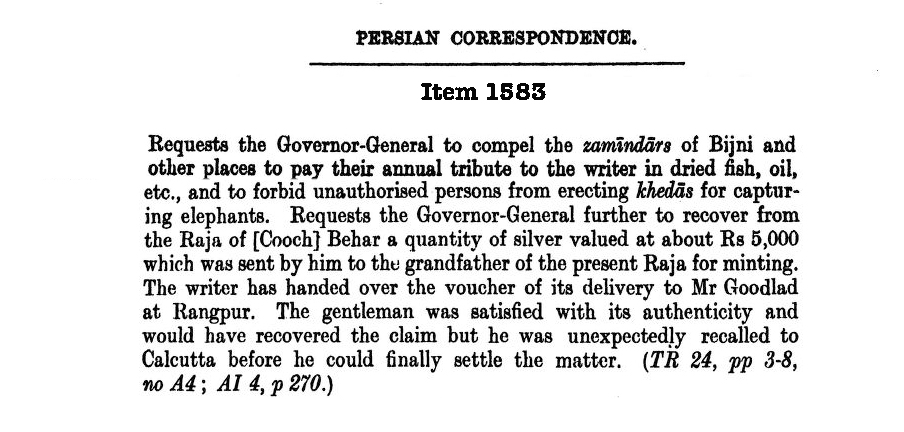
On pages 435-436 of the compilations of correspondences titled “PERSIAN CORRESPONDENCE”, the following appears as item 1583:
The letter addressed to the Governor General of British East India Company was dated 15th January, 1785. Thus, the Druk Desi who authored the letter would have to be Druk Desi Jigme Singye who ruled between 1776 to 1789. From this letter it is clear that Bhutan sent silver to Koch Bihar to be converted to coins. We know that the earliest Bhutanese coins were of silver – only later we began hammering coins in copper.
Although the claim for the silver worth Rs. 5,000.00 is being made in a letter dated 1785, the letter is explicit that the silver was handed over to the grandfather of the incumbent Koch Bihar Raja ruling in 1785. It means that the silver would have had to have been sent to Koch Bihar earlier to 1772 - the logic behind this assumption is explained further down the post.
A Bengali civil servant working for the East India Company by the name of Babu Kishen Kant Bose visited Bhutan in 1815. His comments in relation to coinage in the country are perhaps among the first references to the existence of minting in Bhutan - many years prior to his visit. His report submitted to his superiors records that:
"There was formerly no mint in Bootan, but when the Booteahs carried away the late Raja of Cooch Behar*, they got hold of the dies, with which they still stamp Narrainee Rupees. Every new Deb Raja puts a mark upon the Rupee of his coinage, and alters the weight. The Dhurma Raja also coins Rupees, and besides them, no one else is permitted to put their mark upon the Rupees, but there are mints at Paro, Tongso, and Tagna**".
This firmly establishes that by 1815, Bhutan already had at least three mints – one each at Paro, Trongsa and Tagna. In addition to these three mints, it is also recorded that more of them were pressed into service in later years. The report also names exact locations of the mints – Sisina in Thimphu and Yudrong Choling in Trongsa.
Bhutan had been over lording the poor Koch Biharis – to the point that we had maintained a garrison in the Koch kingdom. However, the garrison was driven away by the British East India forces in 1772. To halt further atrocities by the Bhutanese, the British East India Company annexed Koch Bihar. In an effort to make the Koch Biharis use British India coins, they closed down the Koch Bihari mints – effectively shutting off supplies of coins to Bhutan. Bhutan requested British East India Company to supply coin dies – they were refused - in an effort to force the Bhutanese to use their coins. It appears that the Bhutanese weren’t going to do so – instead they carried off Koch Bihari moneyers and started to hammer our own coins within the country.
NOTE: We always make the mistake of calling Governor General of British India Government. It was the British East India Company that ruled India - until its closure in 1858. Only thereafter the British India Government took over the administration of India.
** Tagna is most likely Dagana.
* The Maharaja of Koch Bihar that the Bhutanese supposedly abducted would have to be either Maharaja Rajendra Narayan (1770 – 1772) or Bijendra Narayan (1772 – 1774).